It’s 2:40 a.m. You roll onto your side, the way you’ve slept for years, and your shoulder lights up. You shift to your back. Then to your other side. By 3:15 you’re awake, doing the math on how many hours are left before the alarm.
By morning it’s a dull ache. By afternoon you’ve almost forgotten it, until you reach for the top shelf, twist back for your seat belt, or lift a kid into a car seat. Then it’s right there again.
If that’s been your last few weeks in Prosper, you’re in good company, and you don’t have to keep trading sides all night. Shoulder pain that gets worse at night is something we help people with commonly.
The Short Version
- The problem: Lying on your side puts your body weight right on the shoulder and the tendons around it. If those tendons are irritated, night is when you feel it. And the shoulder is often where it hurts, not where it starts. Your neck and upper back can be part of the story.
- What helps: Take the pressure off for a few days, support your arm, and back off overhead reaching and heavy lifting. Four simple things are below.
- When that isn’t enough: Get it checked. A chiropractor can find out where it’s really coming from, and the care is gentle: no twisting, no cracking. For a tendon that’s stuck, we also offer focused shockwave therapy.
Why Your Shoulder Hurts More at Night
Your shoulder is built to move, and four small muscles called the rotator cuff do a lot of the work. Their tendons wrap over the top of your upper-arm bone, with a small cushioning sac, the bursa, between the tendons and the bone. When those tendons or that sac get irritated, lying on the shoulder is one of the first things to bring it out. The American Academy of Orthopaedic Surgeons lists pain at night, especially when you’re lying on the affected shoulder, among the symptoms of a rotator cuff injury.
Night pain doesn’t mean something is torn. Irritated tendons, a stiff upper back and a pinched nerve in your neck can all do it, and an exam is how you tell them apart.
Daytime is easier because you’re moving. At night you’re lying still on the same joint for hours. That’s why a shoulder that’s fine at lunch can wake you up at 3.
The Shoulder Is Often Where It Hurts, Not Where It Starts
Here’s a pattern that’s easy to miss. The shoulder gets the blame, but it rarely works alone. Shoulder pain often traces back to your neck, your upper back, or the way your shoulder blade moves. Pain in the shoulder and arm can come from a pinched nerve in your neck rather than the joint itself, and shoulder pain and neck pain are often the same problem showing up in two places.
That’s why rubbing the shoulder or resting it can quiet things down without settling anything. The part that’s setting it off hasn’t been touched.
What Sets It Off Around Prosper
- Racquet sports and golf. Padel is the fastest-growing racquet sport in the Prosper area, and between padel, tennis, pickleball and golf, plenty of people here repeat the same swing several times a week. The AAOS names tennis players among the athletes especially vulnerable to overuse injuries of the rotator cuff.
- Lifting kids. A toddler into a car seat, a shopping cart, a crib, dozens of times a day. The AAOS notes that many jobs and routine chores can overload the rotator cuff too.
- Hours at a desk. Forward-head posture builds strain in the upper back and shoulders over time.
- An old injury that never quite settled. A fall, a sprain, a surgery somewhere else in the body.
Four Things to Try This Week
Start here. None of them cost anything.
- Take the pressure off for a few days. Sleep on your other side or on your back instead of the sore shoulder.
- Give your top arm a pillow. If you’re on your good side, rest the arm on top on a pillow in front of you so it isn’t pulled across your body.
- Cut back, don’t quit. Ease off overhead reaching and heavy lifting while it settles.
- Notice what sets it off. Does it flare when you lift your arm, or when you turn your head? Does one position at your desk bring it on? Jot it down. We’ll ask.
Give it a few days. If it’s easing, keep going. If it’s still waking you up, that’s your answer: time to get it checked.
How We Find Out What’s Behind It at Restoration
At Restoration, it starts with you: where it hurts, which position wakes you up, what you’ve already tried. Then we examine your shoulder, neck and upper back, run a nervous system scan, and usually take digital X-rays, all in our office. You get a doctor’s report in plain language: what we found, what we think is behind it, and what a plan looks like. Here’s what to expect at your first visit.
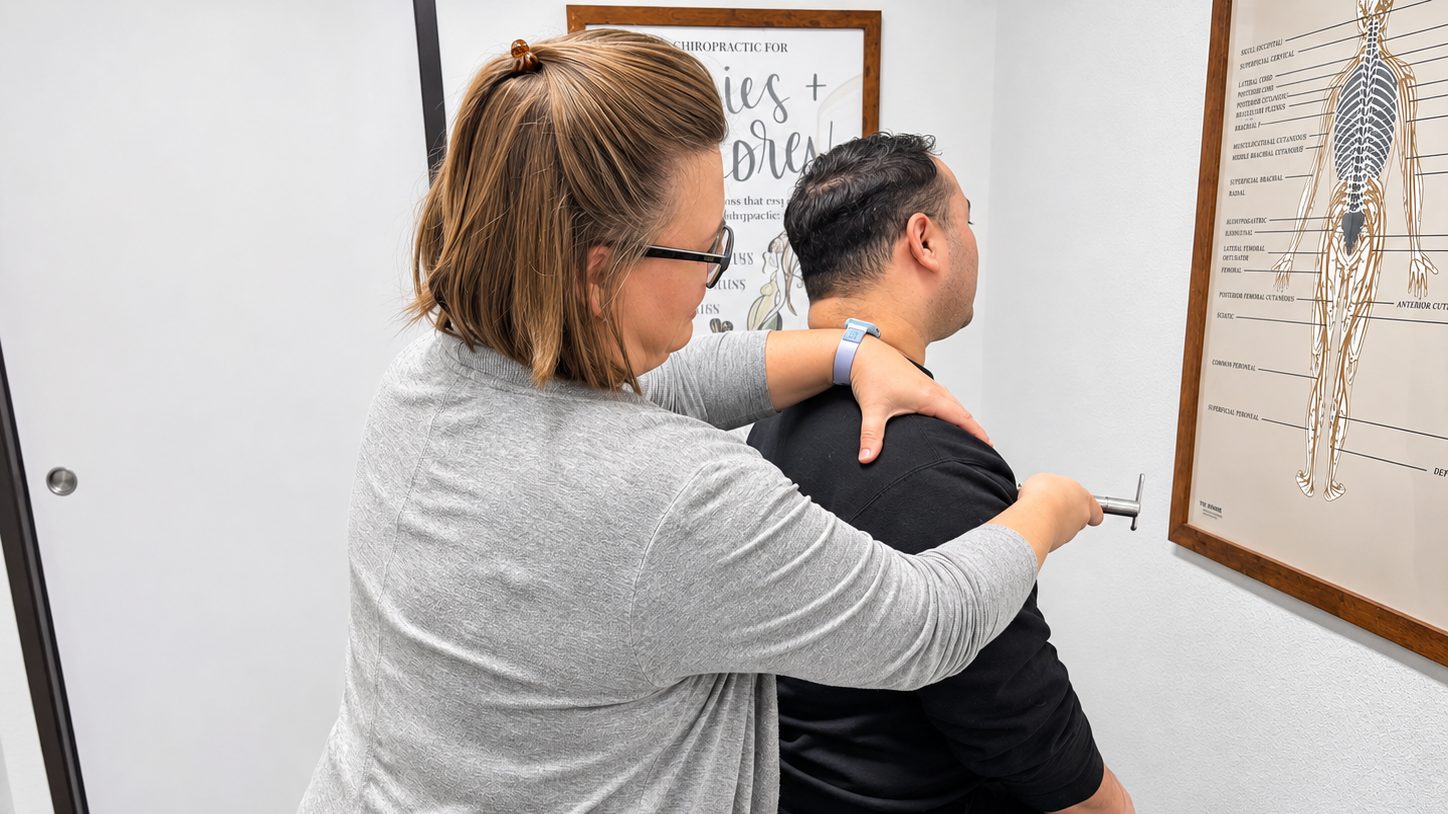
Our care is built around Torque Release Technique, the primary technique we use at Restoration: a small hand-held instrument, a quick, light impulse, no twisting and no cracking, and you stay in a neutral position the whole time. We use it on your spine and nervous system function, then work on the shoulder itself, because treating only the painful joint frequently misses the cause.
When the Tendon Is Stuck: Shockwave Therapy
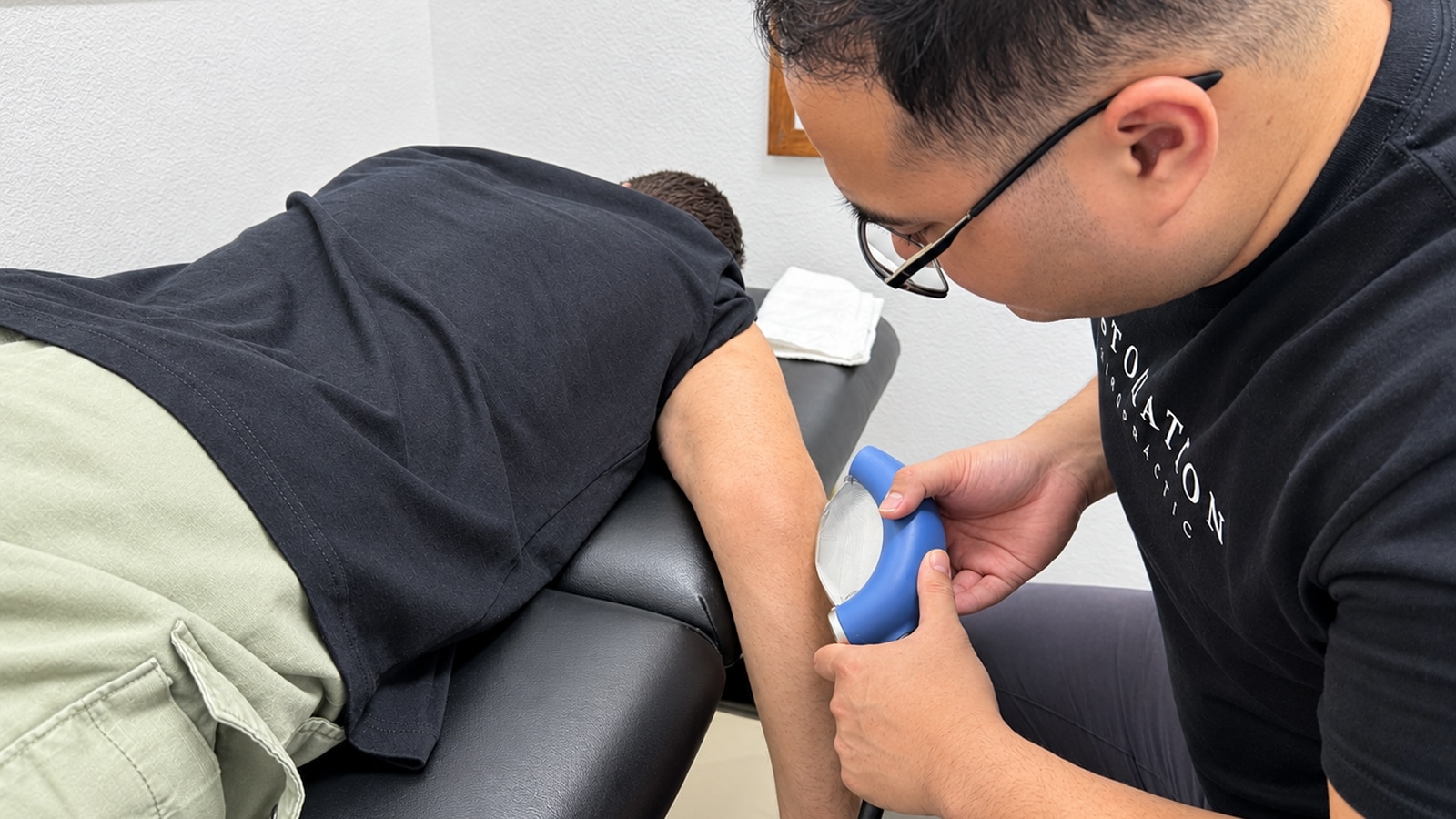
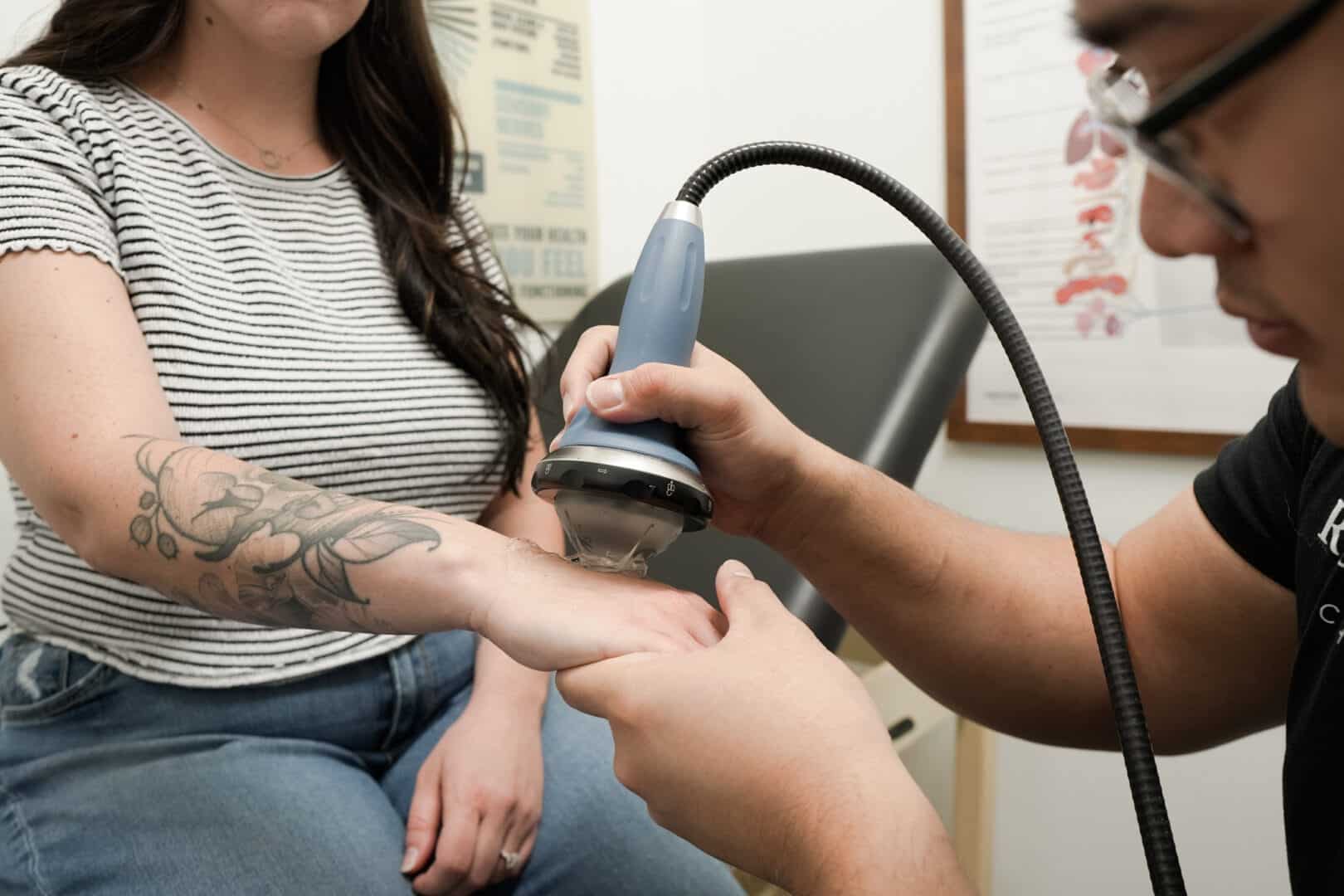
Some shoulders don’t settle with better sleep habits and adjustments, especially when the tendon itself is the stubborn part. That’s what focused shockwave therapy is for. It sends targeted acoustic waves into sore soft tissue to restart the repair that stalled. We use the PiezoWave, a focused device, and a technician trained specifically on it runs every session. Sessions are short, and most people describe the feeling as pressure on a bruise. It’s non-invasive and drug-free.
We’ll tell you honestly at your first visit whether it’s a good fit for your shoulder, and what the plan looks like before you start. Because it’s all in one office on North Coleman Street in Prosper, your neck, your upper back and your shoulder tendon get looked at under one roof.
“After months of waking up in excruciating pain from shoulder and elbow issues, I finally found the solution that worked.”
— Restoration patient, verified Google review
One Honest Thing
We can’t promise a result or a timeline, and some shoulders need more than we do, like an MRI or an orthopedic opinion. We review your imaging and history honestly, and if surgery or another provider is the right next step, we’ll tell you and refer you.
Common Questions
Why does my shoulder hurt more at night than during the day?
Lying on your side puts your weight on the shoulder, and you stay in that position for hours. If the tendons or the sac around the joint are irritated, that’s when they complain. The American Academy of Orthopaedic Surgeons lists night pain, especially on the affected side, as a symptom of rotator cuff injuries. A neck or upper-back problem can also show up as shoulder pain, which is why an exam looks at all three.
Can a chiropractor help with shoulder pain?
Often, though it depends on what’s behind it. We look at your shoulder, neck and upper back, use gentle Torque Release Technique with no twisting and no cracking, and for stubborn tendon pain we offer focused shockwave therapy. We can’t promise a result, and we’ll tell you at your first visit if we think you need something else.
Is shoulder pain at night a sign of a heart problem?
Heart attack discomfort can show up in the shoulders, arms, back, neck or jaw. If your shoulder pain comes with chest pressure or discomfort or shortness of breath, call 911, even if you’re not sure. They’d rather check. If you’re having shoulder pain on its own, a chiropractic exam is a reasonable place to start, and we’ll tell you if anything calls for a doctor first.
Does shoulder pain at night mean I need surgery?
Not by itself. What’s behind it matters, and finding that out is what an evaluation is for. Surgery is occasionally the right call. We review your imaging and history honestly, and if it’s the right next step, we’ll tell you and refer you.
Where can I get shoulder pain checked in Prosper?
Restoration Chiropractic is at 1061 N Coleman St #130 in Prosper, about two miles north of US-380. You can book online or call (972) 818-5820, and you don’t need a referral. We also see patients from Celina, Aubrey, Frisco, McKinney and Little Elm.
Let’s Find Out What’s Waking You Up
A few nights of broken sleep is hard to shake, and you don’t have to guess what’s behind it.
Read how we approach shoulder, hip and knee pain, then book an appointment. We’re at 1061 N Coleman St #130 in Prosper, about two miles north of US-380, and you don’t need a referral.
Or call (972) 818-5820 and ask us whether it’s worth coming in.