It starts as something you notice picking up your coffee. Then it’s there on every backhand. Or at the top of your backswing. Or when you shake hands at the end of a match.
You buy the strap. You take ibuprofen before you play. You skip a week, it feels better, you go back out, and by the second set it’s right where you left it.
If that’s been your summer, you’re in good company, and you’re not stuck with it. This is one of the most treatable problems we see.
The Short Version
- The problem: tennis elbow (outside of the elbow) and golfer’s elbow (inside) are tendon problems, not joint problems. The tendon has been loaded faster than it can repair, and it’s stopped healing properly. That’s why rest calms it down but doesn’t finish the job.
- The fix, most of the time: loosen your grip, check your equipment, cut volume instead of quitting, and give the tendon slow, steady strength work. Six of these are below.
- When that isn’t enough: focused shockwave therapy restarts the repair the tendon couldn’t finish on its own. It’s non-invasive and drug-free, sessions are short, and most players keep playing through treatment.
Why It’s Your Elbow, and Why Now
Tennis elbow is most common between the ages of 45 and 54. That’s no coincidence. Tendons in your forties and fifties still get strong, but they take longer to recover between sessions than they did at 30. Meanwhile, most of us are playing more than we ever have.
The names are misleading, too. You don’t need to play tennis to get tennis elbow, and golfers get both.
- Outside of the elbow (tennis elbow): the tendons that pull your wrist back. A backhand hit late, a padel bandeja, a pickleball dink with a tight grip, or a golf club that strikes the mat first.
- Inside of the elbow (golfer’s elbow): the tendons that curl your wrist and grip. Hitting fat shots, heavy forehand topspin, or holding the club like it owes you money.
Padel deserves its own mention. It’s the fastest-growing racquet sport in the area, the racquet is solid and heavy, and the ball comes off the glass at angles your forearm isn’t used to. In a survey of 800 padel players with an average age of 49, the elbow was the most-injured spot in the upper body, and most of those injuries were tennis elbow.
Here’s what’s actually going on. Every hit puts a small amount of stress into the tendon, and the tendon repairs it before the next session. Play four times a week, add a tournament or a golf trip, and the repair falls behind. Eventually the tissue stops trying. That’s why it feels better after a week off and comes straight back. Rest stops the damage but doesn’t restart the healing.
The Cortisone Shot Question
Plenty of players reach this point and get a cortisone shot. It’s a reasonable thing to reach for, and it works fast. It’s worth knowing what happens after the first month, though.
In a well-known trial published in JAMA, players with tennis elbow who got a cortisone shot were far more likely to have the pain come back within the year than those who got a placebo injection: 54% versus 12%. At one year, fewer of them had fully recovered.
When researchers compared cortisone and shockwave head to head, the pattern was clear. The shot wins the first month. Shockwave pulls ahead at three months and stays ahead at six, for both pain and grip strength.
Quieting the pain and healing the tendon aren’t the same thing. You want the one that still counts in March.
Six Things to Try This Week
Start here. Plenty of players settle down with these alone, and none of them cost anything.
- Loosen your grip. Most elbow pain on the court and the course starts with squeezing too hard. On a scale of 1 to 10, aim for a 4 and let the club or racquet do the work.
- Get your equipment checked. Ask your pro about grip size. Racquet players can also ask about string tension, since a few pounds looser takes load off the forearm. Small changes add up across a few hundred hits.
- Cut volume, don’t quit. Drop a session a week, or play doubles instead of singles. Complete rest tends to end the same way every time: you feel great, go back to full volume, and flare it up.
- Give the tendon slow strength work. Tendons get better with the right kind of load, not without any load. Slow, controlled wrist exercises with a light dumbbell, a few days a week, are the backbone of most tendon rehab. If you’re not sure how, we’ll show you.
- Warm up your forearms. Five minutes of wrist circles and light grip work before you play, not after the first set.
- Treat the strap as a bandage. If a counterforce strap helps you play, wear it. Just know it eases the load without fixing anything, so it’s not a reason to stop doing the rest of this list.
Give it three or four weeks of actually doing it. If the elbow is improving, keep going. If it’s not, that’s your answer.
When the Elbow Won’t Cooperate: Shockwave Therapy
If you’re three months in, it’s past the point of rest and stretches doing much. That’s exactly where shockwave therapy is useful.
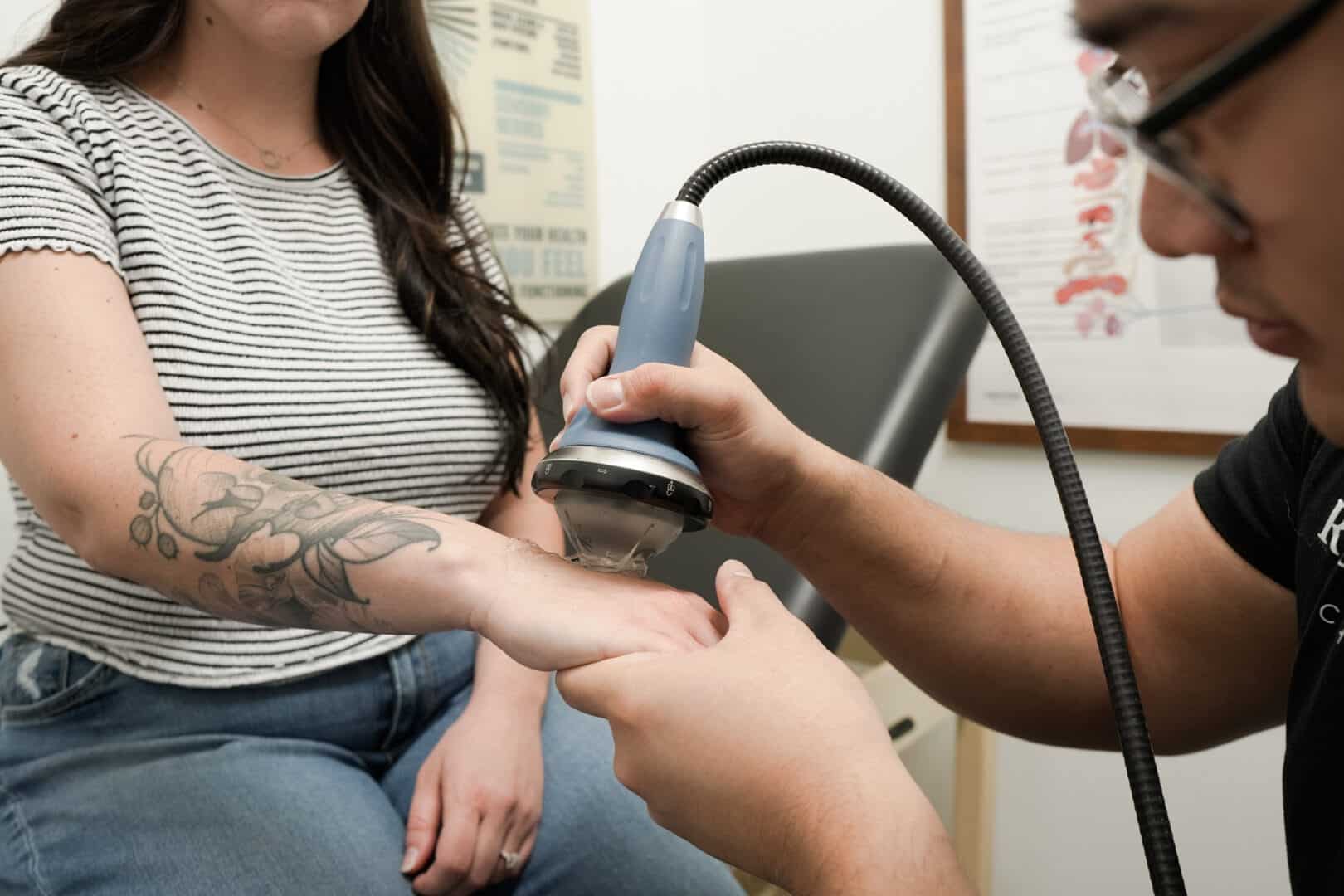
Shockwave delivers focused acoustic energy into the damaged tendon. That increases blood flow, triggers the body’s healing response, and restarts the repair process the tendon stalled on.
The research backs it up. A 2025 review that pooled nine earlier analyses of tennis elbow found shockwave reduced pain more than placebo, more than ultrasound therapy, and more than cortisone injections. Most of that research looks at tennis elbow because it’s far more common. Golfer’s elbow is the same kind of tendon problem on the other side of the joint, and we treat it the same way.
Why the Device Matters
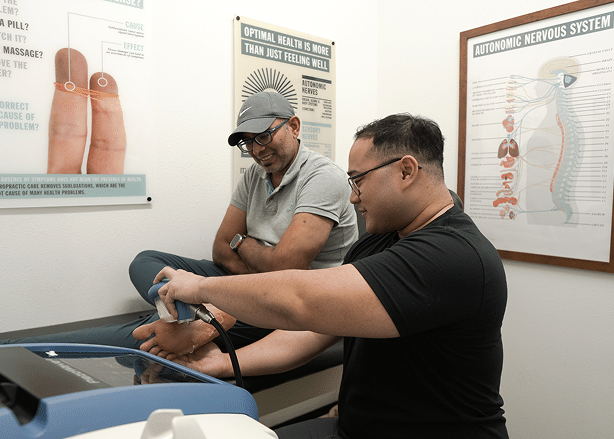
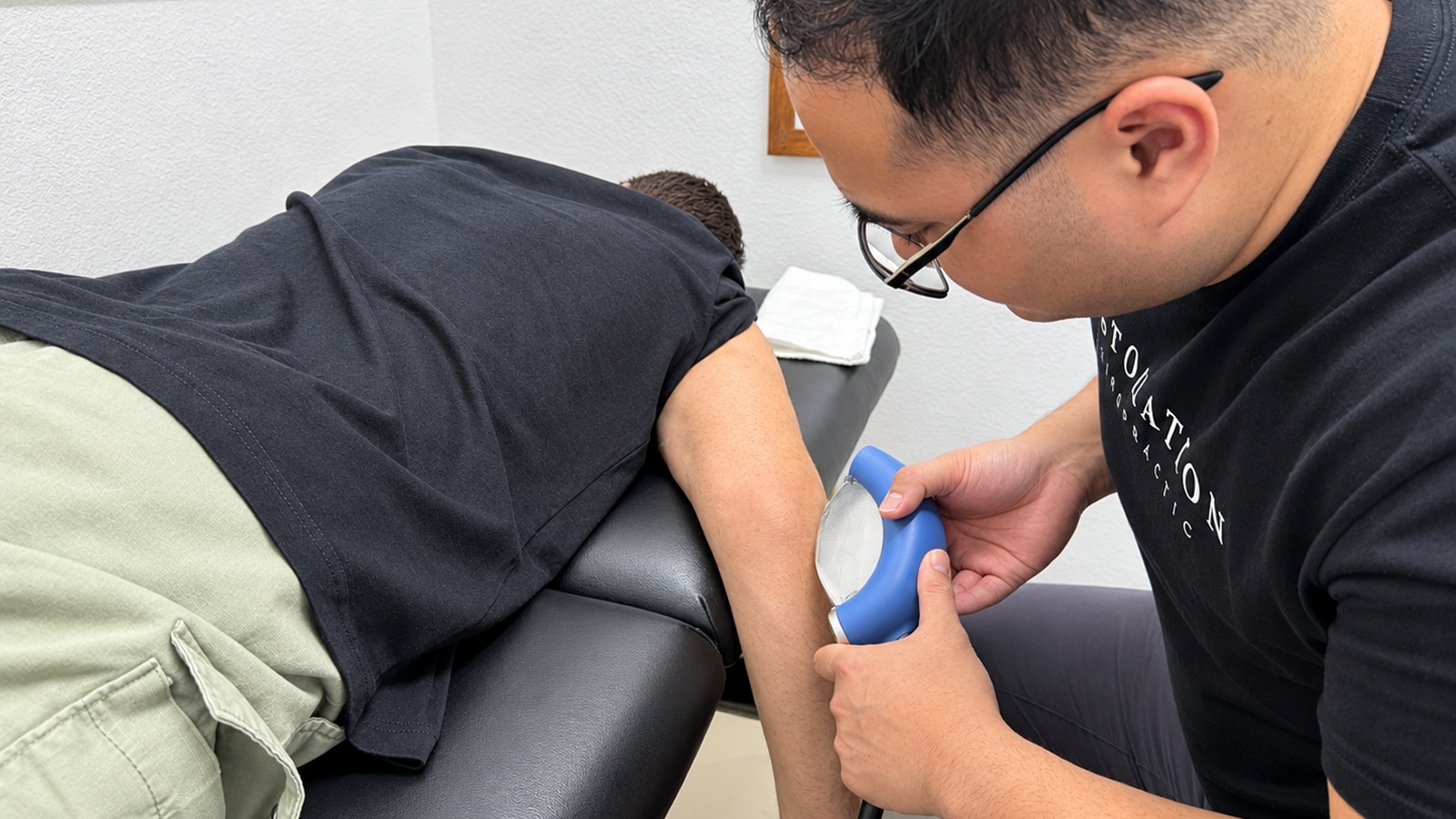
We use the PiezoWave, a focused shockwave device. Most offices that offer shockwave use radial devices, which spread energy across a broad area near the surface. A focused device concentrates it at the exact depth of the injured tissue. We invested in it because the results are meaningfully better for exactly this kind of stubborn, chronic problem.
What It’s Like
- It starts with an evaluation. We take a full history and examine you to confirm shockwave is the right fit and rule out anything that would make it the wrong one. Then your doctor walks you through what’s causing the pain, how many sessions we recommend, and what it will cost, all before you start.
- Sessions are short. About 10 to 15 minutes, delivered by a technician trained specifically on the PiezoWave. Most people describe it as pressure on a bruise. It’s unusual at first, then very manageable.
- Most people need 3 to 6 sessions, scheduled weekly or more than once a week, so it fits around your season. Many notice a change within the first three to five, and the tendon keeps healing for weeks after the last one.
- You can keep playing. There’s no downtime. Expect some mild soreness for a day or two after a session, like after a deep-tissue massage. Most athletes keep training through treatment, not instead of it, and we’ll tell you how much is sensible while the tendon heals.
We Also Look Above the Elbow
A shoulder that doesn’t rotate well, or a stiff upper back, makes the forearm do work it shouldn’t. When that’s part of the picture, we pair shockwave with gentle chiropractic adjustments to address the whole chain, not just the sore spot. And if the pain comes with tingling or numbness into your hand, it may be starting at a nerve in your neck, not at the elbow. That’s worth finding out before treating the wrong spot. See pinched nerve relief.
One patient put it this way in a verified Google review: “After months of waking up in excruciating pain from shoulder and elbow issues, I finally found the solution that worked.”
Two Things We Want You to Know
See a physician first if it happened all at once. If you felt a pop, can’t fully straighten or bend the arm, or have real swelling or bruising after a fall, have it imaged before anything else. That’s a different injury, and it’s not one shockwave is designed for.
We won’t promise you a number. Some elbows respond in a few sessions and some take the full plan. What we will do is tell you honestly at the first visit whether you’re a good candidate, and show you what the plan and cost look like before you commit to anything.
Get Your Game Back
You’re not too old for this, and you don’t have to play around it for another season. An elbow that has been sore for months is a tendon stuck partway through repair, and that’s a very fixable problem.
Try the six fixes first. If it’s still there in a few weeks, read how shockwave therapy works at Restoration, then book an appointment. We’re on North Coleman Street in Prosper, and sessions fit around a tee time.
Or call (972) 818-5820 and ask us whether it’s worth coming in.