If you’re in Prosper, Frisco, or anywhere across North Texas and you’ve got a burning, tingling, or shooting pain that won’t quit, you’ve probably searched pinched nerve chiropractor near me and wondered whether a chiropractor can actually fix it — or just offer temporary relief. It’s a fair question, and the answer is more encouraging than most people expect.
Short version: most pinched nerves come from mechanical compression — exactly the kind of problem chiropractic care is built to relieve. The key is confirming that’s the cause before you start, which is what a proper evaluation is for. Here’s what’s actually going on, and how to know if chiropractic is right for you.
What Is a Pinched Nerve, Really?
A “pinched nerve” — clinicians call it nerve compression, or radiculopathy when it happens at the spine — is what you feel when surrounding tissue presses on a nerve and disrupts the signal traveling through it. That pressure can come from a bulging or herniated disc, a bone spur, swollen muscle, or joints that have drifted out of alignment and narrowed the space the nerve needs.
The nerve doesn’t stay quiet about it. Because nerves carry signals well beyond the spot that’s compressed, symptoms often show up away from the actual problem — which is why a pinched nerve in your neck can light up your hand, and one in your lower back can run all the way down your leg.
Where Does It Happen — and What Does It Feel Like?
Pinched nerves tend to cluster in a few predictable spots:
- The neck (cervical spine) — pain, tingling, or numbness traveling into the shoulder, arm, or hand, often worse after sleeping wrong.
- The lower back (lumbar spine) — pressure on a lumbar nerve root frequently becomes sciatica: pain shooting through the buttock and down the leg.
- The shoulder blade and upper back — a deep, aching or burning pain between the shoulder and the spine.
The sensations are distinctive: pins-and-needles tingling, numbness, a burning or electric quality, sharp shooting pain, or weakness — a hand that loses its grip, or a foot that catches when you walk. Many patients also notice it hurts more at night, when lying down shifts pressure on the nerve and the daytime distractions that masked it are gone.
So, Can a Chiropractor Help a Pinched Nerve?
For most people, yes — and here’s the logic. Pain medication and rest manage the symptoms: they quiet the alarm without changing why it’s going off. That’s fine for a few days, but if the underlying compression doesn’t change, the pain returns the moment the medication wears off. Surgery sits at the other extreme — effective for severe or progressive cases, but a major step for a problem that usually responds to conservative care.
Chiropractic lives in the middle, and that’s where most pinched nerves belong. By restoring normal motion and alignment to the joints around the affected nerve, the goal is to take pressure off the nerve itself — addressing the mechanical cause instead of masking the signal. When a pinched nerve is driven by alignment, disc pressure, or joint restriction (and most are), that’s exactly the problem chiropractic is designed to solve.
The honest caveat: a small number of cases come from something that isn’t mechanical, and adjustments won’t be the answer for those. That’s why the evaluation matters as much as the treatment.
How We Treat Pinched Nerves at Restoration
Before anything else, we figure out exactly where the nerve is being compressed — guessing isn’t good enough when a nerve is involved. That means NASA-certified nervous system scanning to see how your nerves are functioning, plus on-site digital X-rays to pinpoint the structural source. Only then do we build a plan.
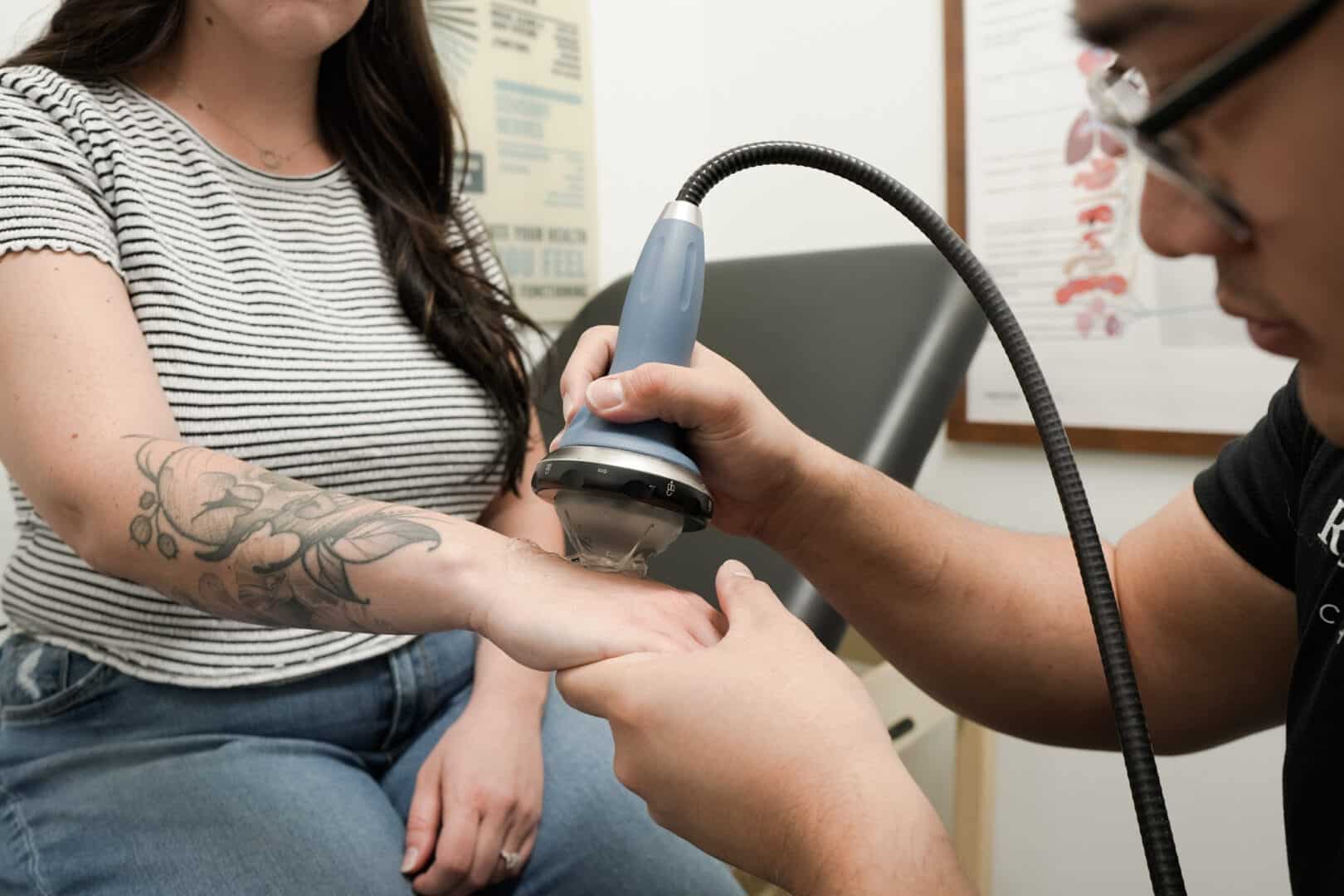
When it’s time to treat, we use the Torque Release Technique — a gentle, instrument-assisted adjustment with no twisting, cracking, or aggressive force. That matters with a pinched nerve, because an already-irritated nerve is the last thing you want to manipulate forcefully. Dr. Jake and Dr. Stephanie tailor the plan to your specific compression point and how your body responds.
See our full Pinched Nerve Relief approach →
How Long Until a Pinched Nerve Heals?
This is the question everyone asks, so here’s a straight answer: it varies, and any clinic that promises an exact number on day one is guessing. Many pinched nerves improve noticeably within a few weeks of consistent care; ones you’ve lived with for months — or that involve significant disc changes — heal more gradually. Two things drive the timeline most: how long the nerve has been compressed before you start, and how consistent you are with the plan. The earlier you address it, the better nerves tend to recover.
When Should You See a Doctor Right Away?
Chiropractic helps the large majority of pinched nerves, but a few symptoms are signals to seek urgent medical care first rather than wait:
- Progressive or sudden weakness in an arm or leg (not just numbness).
- Loss of bladder or bowel control, or numbness in the groin or saddle area.
- Pain following a significant trauma, like a car accident or fall.
- Symptoms that are rapidly getting worse rather than holding steady.
These are uncommon — but a thorough evaluation, which is how we start every visit, is designed to catch them and point you in the right direction from the beginning.
Pinched Nerve Relief in Prosper
If you’ve been living with tingling, numbness, or shooting pain and hoping it sorts itself out, the most useful next step is simply finding out what’s causing it. A pinched nerve addressed early is far easier to resolve than one that’s been compressed for months — and you don’t have to keep guessing. We care for patients from Prosper, Celina, Aubrey, Frisco, McKinney, and Little Elm, and your first visit includes the scanning, exam, and X-rays needed to tell you honestly whether chiropractic can help your case.
Every new patient starts with a full evaluation and a clear, honest conversation about what we find — no pressure, no overpromising. If we’re a good fit for what you need, we’ll tell you. And if your situation calls for another provider, we’ll tell you that too.
You’ve got enough going on without nerve pain running the show. Let us help you find the source. Schedule your first visit → or call us at (972) 818-5820.