If you’ve just been told you have a herniated disc, you’re probably somewhere between worried and overwhelmed. Maybe surgery has already come up. Maybe you’ve been handed a prescription and told to wait it out. And somewhere in the middle of that, you’re wondering whether a chiropractor can actually do anything about it — or whether going to one might make things worse.
Those are fair questions, and they deserve straight answers.
The Short Answer
- Yes, chiropractic care can help most herniated discs. In a study of 148 patients with MRI-confirmed lumbar disc herniations, 90.5% reported meaningful improvement at three months and 88% were still improved a year later.
- Most herniated discs heal without surgery. Research tracking untreated herniations found roughly 70% shrink or resorb on their own — and the larger, more dramatic ones resorb most readily.
- The technique matters more than the question of whether to go. High-velocity twisting adjustments aren’t appropriate for every disc patient. Gentle, instrument-based adjusting is.
- A herniation on your MRI may not be what’s causing your pain. Disc protrusions show up in 29% of pain-free 20-year-olds.
- Surgery is genuinely the right answer for a smaller group of patients — and there are specific red flags that mean you should skip conservative care and be evaluated now. They’re listed below.
Can a Chiropractor Help a Herniated Disc?
For most people, yes — and it’s usually worth trying before anything irreversible.
A herniated disc causes pain through a chain of problems: the disc material itself, the inflammation around it, the nerve it’s pressing on, and the compensation patterns your body builds up trying to protect the area. Chiropractic care addresses that chain — restoring motion where the spine has locked down, reducing pressure on the affected nerve, and unwinding the compensation that’s often producing as much of your day-to-day pain as the disc is.
The best available evidence on this is encouraging. A 2014 study in the Journal of Manipulative and Physiological Therapeutics followed 148 patients with MRI-confirmed, symptomatic lumbar disc herniations through a course of spinal manipulation. 90.5% reported clinically meaningful improvement at three months, and 88% were still improved at one year. Notably, it worked for long-standing cases too — 89.2% of the chronic patients were improved at the one-year mark.
That’s not a guarantee, and it’s not every case. But it’s a strong reason to try conservative care before assuming the only way out is a procedure.
Herniated, Bulging, or “Slipped” — Does It Change the Answer?
Not much, and that’s worth knowing if you’ve been given different words by different people.
These terms describe points on the same spectrum. A bulging disc has pushed outward but its outer layer is still intact. A herniated disc means the softer inner material has pushed through a tear in that outer layer. “Slipped disc” isn’t a precise medical term at all — discs don’t actually slip out of place — it’s just how the sudden, sharp version of this tends to feel.
The evaluation is the same for all three, and so is the general approach to care. If you want the full breakdown of each type, including degenerative disc disease, our herniated disc chiropractor page walks through them in detail.
What Most People Don’t Know About Herniated Discs
Two facts reframe this whole decision, and most patients never hear either one.
First: the herniation on your MRI may not be the thing causing your pain. A large systematic review in the American Journal of Neuroradiology looked at imaging of people with no back pain at all. Disc protrusions turned up in 29% of pain-free 20-year-olds and 43% of pain-free 80-year-olds. Disc bulges were even more common — 30% at age 20, rising to 84% by age 80. The authors concluded that many of these findings are simply part of normal aging and aren’t associated with pain.
That doesn’t mean your pain isn’t real. It means the picture alone doesn’t tell you where the pain is coming from — which is exactly why a hands-on evaluation matters as much as the imaging.
Second: discs heal. A systematic review in Clinical Rehabilitation calculated the probability of a lumbar herniation regressing on its own and found an overall resorption rate of about 70%. The counterintuitive part: the worst-looking herniations resorbed the most reliably. Sequestrated discs — the most severe category — regressed 96% of the time, while mild bulges regressed only 13% of the time.
So a dramatic MRI is not the emergency it feels like. For most people this isn’t a “fix it now or live with it forever” problem. It’s a “support the healing that’s already trying to happen” problem.
Can a Chiropractor Make a Herniated Disc Worse?
This is the question people are most nervous to ask, so let’s take it seriously.
The honest answer: the wrong technique on the wrong patient can aggravate a disc. High-velocity manual adjustments — the kind involving heavy twisting and cracking — aren’t appropriate for every disc case. Anyone who tells you technique doesn’t matter here isn’t being straight with you.
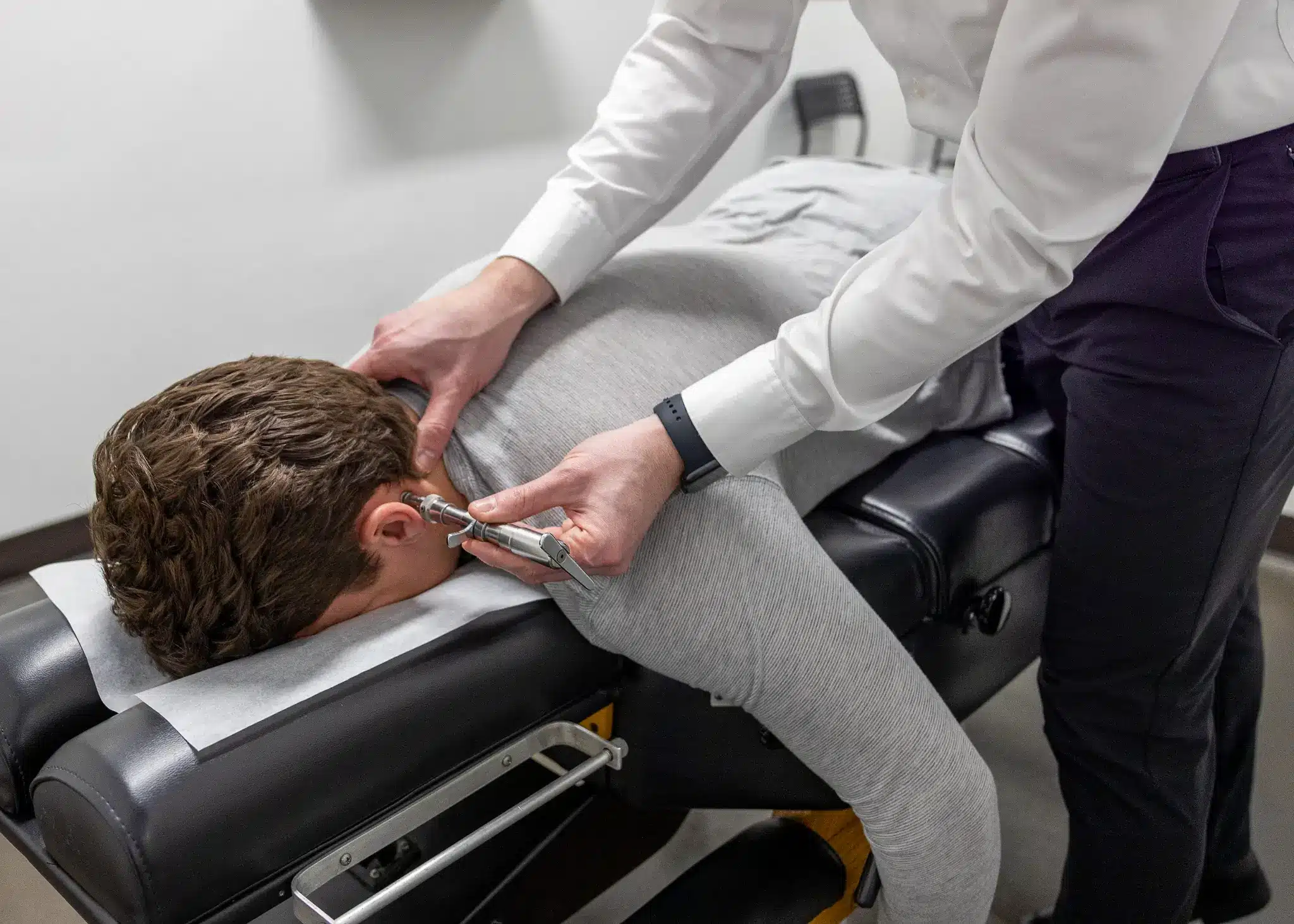
That’s precisely why the primary adjusting method at Restoration is the Torque Release Technique (TRT). TRT uses a hand-held instrument called the Integrator to deliver a precise, pre-measured impulse to a specific point on the spine — no twisting, no cracking, no heavy force. The impulse is delivered in about 1/10,000th of a second, faster than your body can tense up against it. Every doctor on staff is Advanced Proficiency Certified in TRT, and when a case calls for manual adjusting, that’s used too — sometimes in combination. The goal is the right method for your case, not loyalty to a single one.
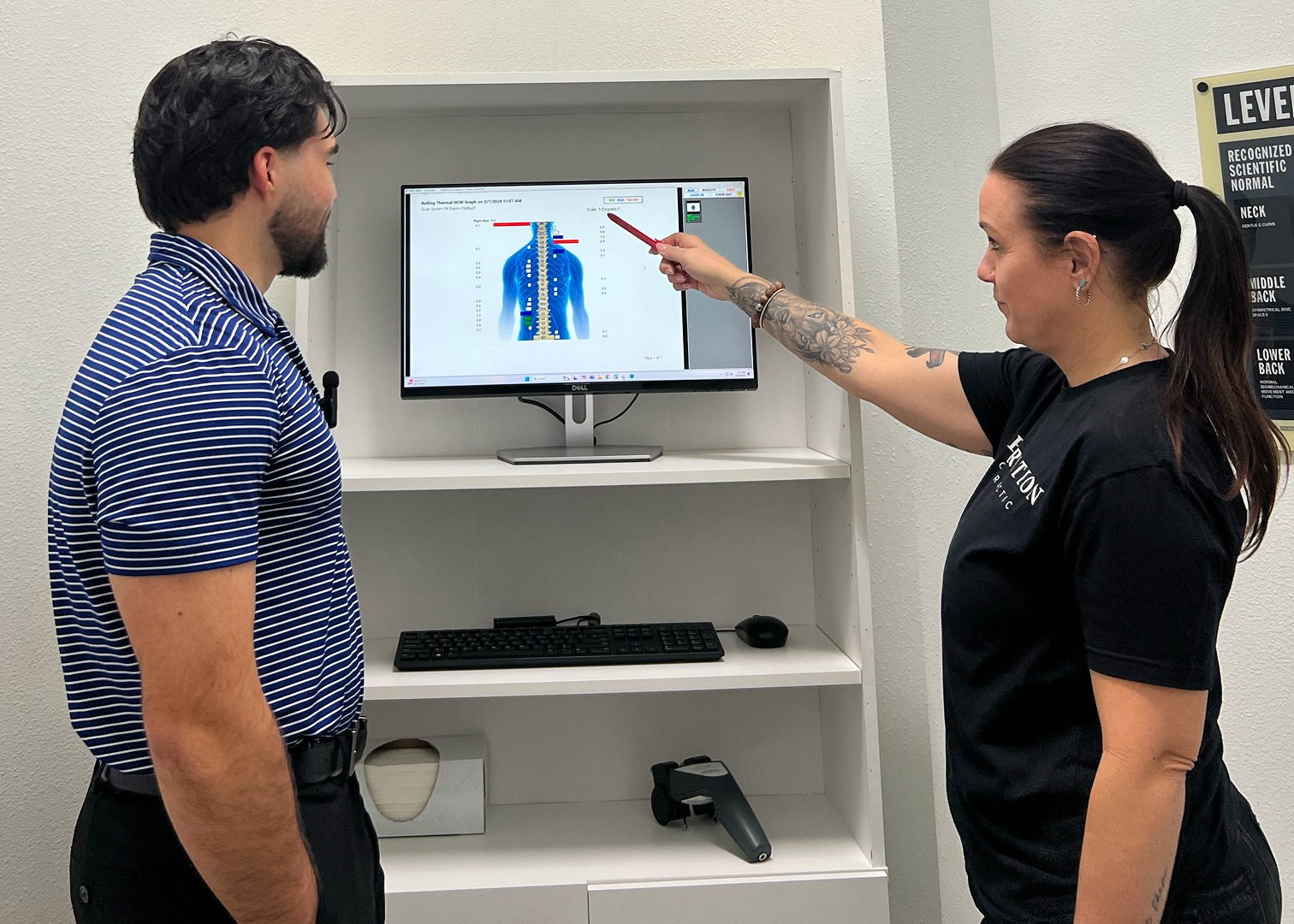
The other half of the safety answer is knowing what you’re working with before anyone adjusts anything. Every new disc patient here gets on-site digital X-rays and a nervous system scan first, so the care plan is built on what’s actually happening in your spine rather than a guess.
Can a Chiropractor Tell If You Have a Herniated Disc?
A chiropractor can identify the signs of a disc problem — and often tell you with real confidence that one is likely — through a physical and neurological exam: orthopedic testing, reflexes, muscle strength, sensation, and where your symptoms radiate. On-site digital X-rays add spinal alignment, disc spacing, and structural findings to that picture.
What imaging like an X-ray can’t do is visualize the disc itself. Only an MRI definitively confirms a herniation. You don’t necessarily need one to begin care — but if the exam suggests significant nerve compression, the right move is a referral out for an MRI before proceeding, not adjusting around the uncertainty. If you already have an MRI, bring it to your first visit.
What Chiropractic Care for a Herniated Disc Actually Involves
Here’s the realistic version, because “it depends” isn’t helpful.
Your first visit is evaluation, not just treatment. A consultation about your history and what you’ve already tried, a nervous system scan, on-site digital X-rays, and then a doctor’s report walking you through what was found and what the plan looks like — including a realistic timeline.
Adjustments are gentle and specific. Instrument-based, targeted to the segments the scan and imaging identify, and tailored to your disc’s condition rather than a generic protocol.
Soft tissue often needs attention too. When a disc has been compromised for a while, the surrounding muscles take on compensating load, producing tightness and scar tissue that adjustments alone don’t fully reach. Shockwave therapy is used for that in stubborn cases.
It’s a course of care, not a single fix. Recent disc issues often show improvement within the first one to two weeks. More established problems generally take longer — meaningful improvement over roughly four to eight weeks of consistent care, with progress continuing beyond that.
Chiropractor, Physical Therapy, Injections, or Surgery?
Most guidelines recommend a stepped approach — conservative care for 4–12 weeks, targeted intervention if that stalls, and surgical consultation reserved for cases that don’t respond or that present red flags. Skipping straight to the last step isn’t how most reputable specialists practice. Here’s how the options actually differ:
Chiropractic care. Restores spinal motion and alignment, reduces pressure on the affected nerve, and addresses compensation patterns. Best for most non-emergency cases, including those with sciatica or radiating leg pain without progressive neurological deficits. Trade-off: it’s a series of visits over weeks, and technique selection genuinely matters.
Physical therapy. Builds strength and stability in the muscles supporting the spine and teaches movement patterns that reduce re-injury risk. Best used alongside chiropractic care rather than instead of it — it doesn’t directly address alignment or nerve interference, and the two compound well.
Epidural steroid injections. Deliver anti-inflammatory medication around the affected nerve. Genuinely useful for severe inflammatory pain as a bridge to other care. Trade-off: relief is temporary, typically weeks to a few months, and the underlying disc and alignment issues are untouched. Repeat injections have diminishing returns.
Surgery (microdiscectomy or laminectomy). Removes the portion of disc pressing on the nerve. The right call for progressive neurological symptoms or pain that hasn’t responded to months of genuine conservative care. Outcomes are good for well-selected candidates — but long-term studies consistently show conservative care produces comparable results for non-emergency cases when given enough time.
When You Should Skip Straight to Medical Evaluation
Some presentations are not candidates for conservative care first. If any of these apply to you, seek medical evaluation now rather than booking a chiropractic visit:
- Loss of bladder or bowel control, or numbness through the groin or saddle area — possible cauda equina syndrome, a surgical emergency
- Progressive muscle weakness — foot drop, or weakness clearly worsening over days or weeks
- Severe, intractable pain that hasn’t responded to any conservative measure over a meaningful period
- Months of persistent pain and dysfunction despite a real, committed course of conservative care
If none of these apply, conservative care is almost always worth trying first. And if a case here genuinely needs surgical evaluation, patients are told so directly.
What We See in Practice
Beyond the published research, disc cases are a significant share of the patients walking through the door here — many arriving after exhausting other options, some having already been told surgery was next.
One patient described it this way in a verified Google review: “I had been suffering from chronic lower back pain due to a herniated disc at L3. I decided to try chiropractic care — I’m so glad I did. The chiropractor used gentle adjustments and targeted therapies to relieve the pressure on my spine. After a few weeks of regular sessions, my pain significantly reduced, and I regained my mobility.”
That pattern — steady improvement over a few weeks of consistent care rather than an overnight fix — is the realistic picture for most disc patients.
What we won’t tell you. We won’t promise you a specific outcome. Disc cases vary enormously by severity, duration, and what’s already been tried, and a portion of patients genuinely do need surgical evaluation. What you will get is a straight assessment after your first visit of whether we think you’re a good candidate — and if we don’t think we’re the right answer for your case, we’ll say so.
How to Choose a Chiropractor for a Herniated Disc
If you’re evaluating options — here or anywhere — these are the questions worth asking:
- Do they image before they adjust? For a disc case, adjusting without knowing spinal alignment and disc spacing is guesswork.
- What technique do they use, and can they adapt it? A practice that only offers high-velocity manual adjusting has one tool for a problem that often needs a gentler one.
- Will they tell you if you’re not a good candidate? A chiropractor who thinks they can help every disc case is someone to be cautious about.
- Do they coordinate with other providers? Referring out for an MRI when the exam warrants it is a sign of good practice, not a lack of confidence.
- What does their track record look like over time? Sustained review volume — hundreds of reviews accumulated over years, not a burst of recent ones — is a real signal. Then read them for situations that resemble yours.
For what it’s worth on our end: all of our doctors are Advanced Proficiency Certified in Torque Release Technique, every new disc patient is imaged and scanned before any adjustment, and we’ve been serving families in Prosper since 2018 with 525+ five-star reviews.
Common Questions
Can a chiropractor fix a herniated disc?
“Fix” is the wrong frame — no provider, surgeon included, restores a disc to its original state. What chiropractic care can do is reduce the pressure and irritation causing your symptoms while supporting the body’s own resorption process, which research shows occurs in roughly 70% of herniations. In the largest study of MRI-confirmed cases treated with spinal manipulation, 90.5% of patients reported meaningful improvement at three months.
Can a chiropractor make a herniated disc worse?
Only if the wrong technique is applied to the wrong patient. High-velocity manual adjustments aren’t appropriate for every disc case, which is why the primary method used here is gentle, instrument-based, and preceded by on-site digital X-rays so nothing is adjusted blindly.
Can a chiropractor tell if I have a herniated disc without an MRI?
A chiropractor can identify the signs through orthopedic and neurological examination plus on-site digital X-rays, and often say with confidence that a disc problem is likely. Only an MRI definitively confirms one. If the exam suggests significant nerve compression, you’d be referred out for imaging before care proceeds.
Should I see a chiropractor or a physical therapist for a herniated disc?
They address different things and work well together. Chiropractic care targets spinal motion, alignment, and nerve pressure; physical therapy builds the strength and movement patterns that keep the problem from returning. Many patients do both.
Is chiropractic care safe for a bulging or slipped disc?
Yes — bulging, slipped, and herniated discs sit on the same spectrum, and the gentle, instrument-based approach is appropriate across all of them. The evaluation process is identical.
How long before I feel relief?
It varies by case. Recent disc problems often show improvement within the first one to two weeks of consistent care. More established cases typically take longer — most patients see meaningful improvement across four to eight weeks, with continued progress after that. You’ll get a realistic timeline in your doctor’s report after the first visit.
Do I need a referral or insurance?
No. No referral is needed, and patients are seen regardless of insurance status.
Talk to Us About Your Disc Pain
If you’ve been told you have a herniated disc — whether you were diagnosed last week or you’ve been managing it for years — the useful next step is finding out exactly what you’re dealing with before deciding anything.
Learn more about our approach on the Herniated Disc Chiropractor in Prosper page, or book a first visit. Your first appointment includes a full evaluation, a nervous system scan, on-site digital X-rays, and a doctor’s report explaining what we found and what your options are — including an honest answer about whether we think we can help.