Almost every parent who calls us about their baby asks the same question within the first thirty seconds, usually in a slightly apologetic voice: “Is that… safe? For someone that small?”
It’s the right question. It’s the one we’d want you to ask. And the honest answer is that it depends far less on your baby’s age than on who is doing the adjusting and how much force they’re using — which is exactly why the answer deserves more than a yes.
TL;DR: A baby’s adjustment is not a smaller version of an adult’s — there’s no twisting, cracking, or popping, just light fingertip pressure, often no more than you’d use to check the ripeness of a tomato. We see newborns just days old, because the birth process itself can place stress on a baby’s spine and nervous system. The credential that matters is ICPA certification, and you should ask about it directly. Parents most often come in for colic, latch difficulties, sleep, torticollis, and recurring ear infections — and you stay in the room for every part of the visit.
Why Would a Baby Need a Chiropractor?
The short answer: because birth is a physical event, and babies are physical beings.
We tend to think of a spine as something that starts accumulating wear later — from backpacks, desks, car accidents, decades of indifferent posture. But a baby’s first mechanical stress arrives before their first breath. The birth process can stress a baby’s spine and nervous system, and that holds across a wide range of deliveries — long labors, fast ones, back labor, assisted deliveries, and C-sections alike.
That matters because of what the spine is protecting. Pediatric chiropractic focuses on the relationship between the spine and the nervous system — which controls every function in the body. In a newborn, that system is doing an extraordinary amount at once: learning to feed, to digest, to regulate sleep, to hold a head up, to settle.
Early checks help address colic, latch difficulties, sleep issues, and torticollis before they compound.
That last phrase is the one parents tend to underline. A slight preference for turning one direction at three weeks is a much smaller conversation than the same preference at nine months, after it has already shaped how a baby rolls, sits, and crawls.
What Does an Infant Adjustment Actually Look Like?
This is where most parents’ mental picture is simply wrong — understandably so, because the picture in their head is of an adult adjustment.
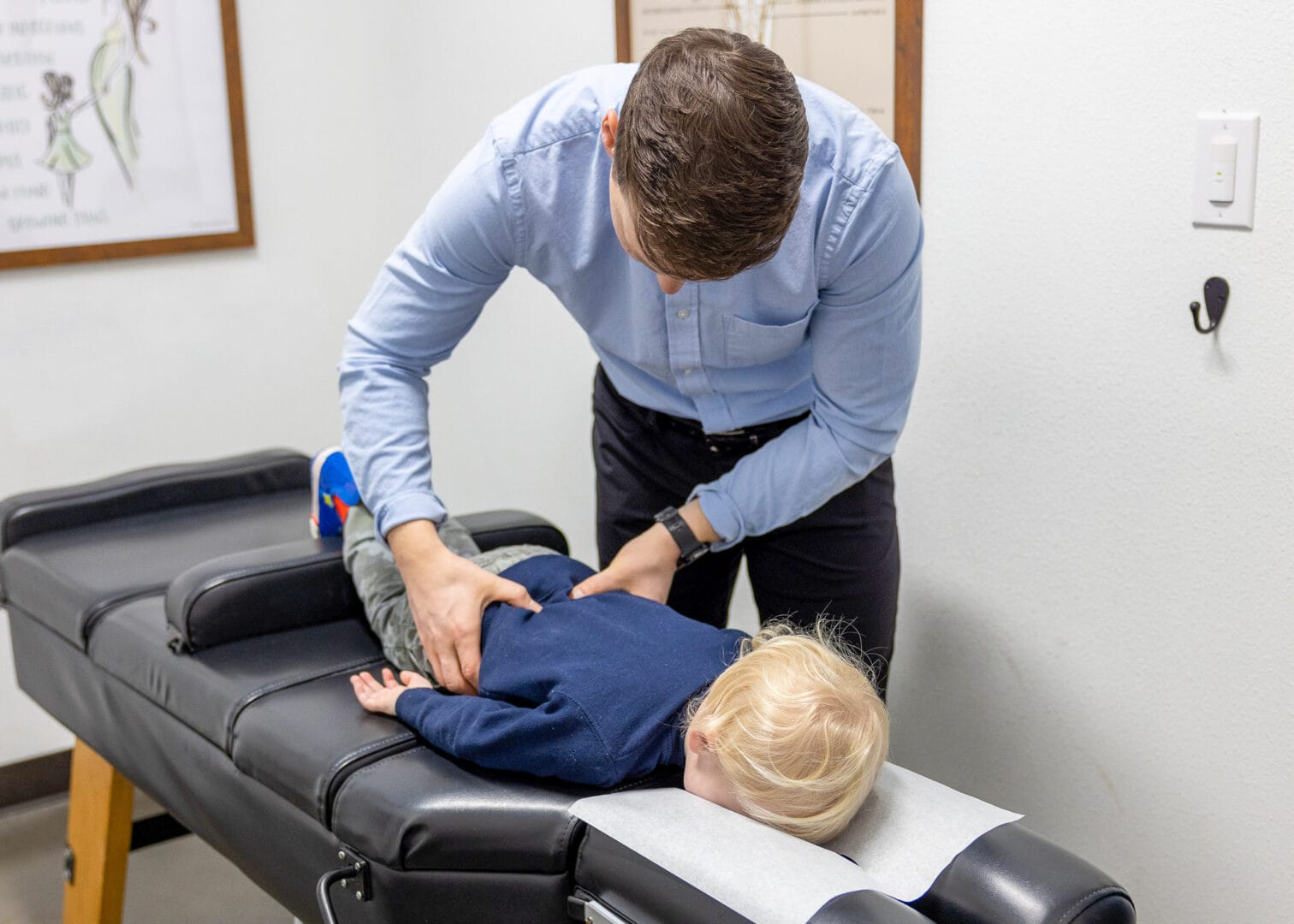
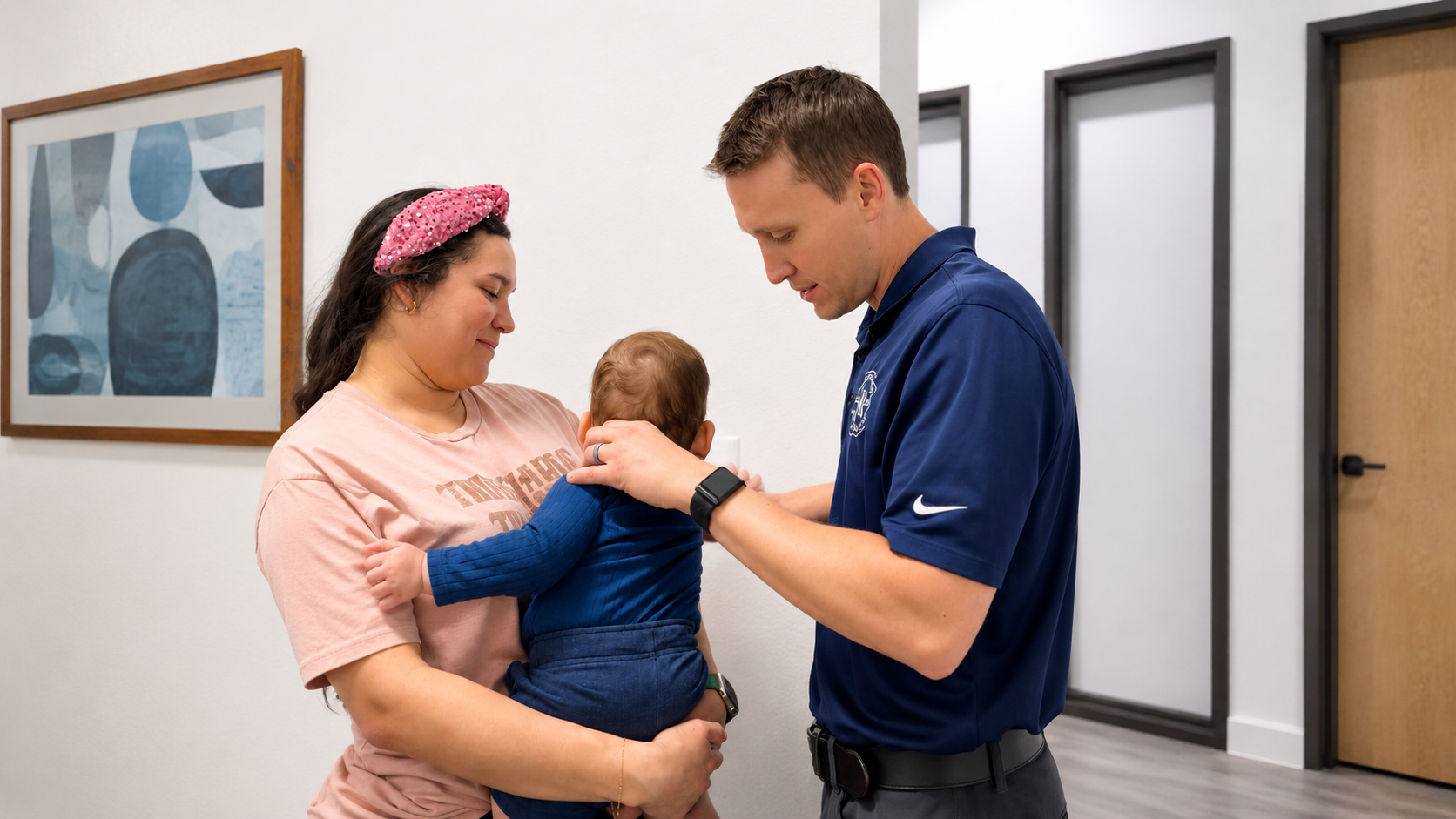
Pediatric adjustments are nothing like adult adjustments. There’s no cracking or twisting. We use the tip of a finger with minimal pressure, specifically calibrated to your child’s size and age. For infants, the pressure is similar to what you’d use to check the ripeness of a tomato. The adjustment is gentle, quick, and most babies sleep right through it.
Go press your thumb against a tomato on the kitchen counter. That is the order of force we’re describing. Parents are routinely surprised — the most common reaction after a first infant adjustment is some version of “wait, that was it?”
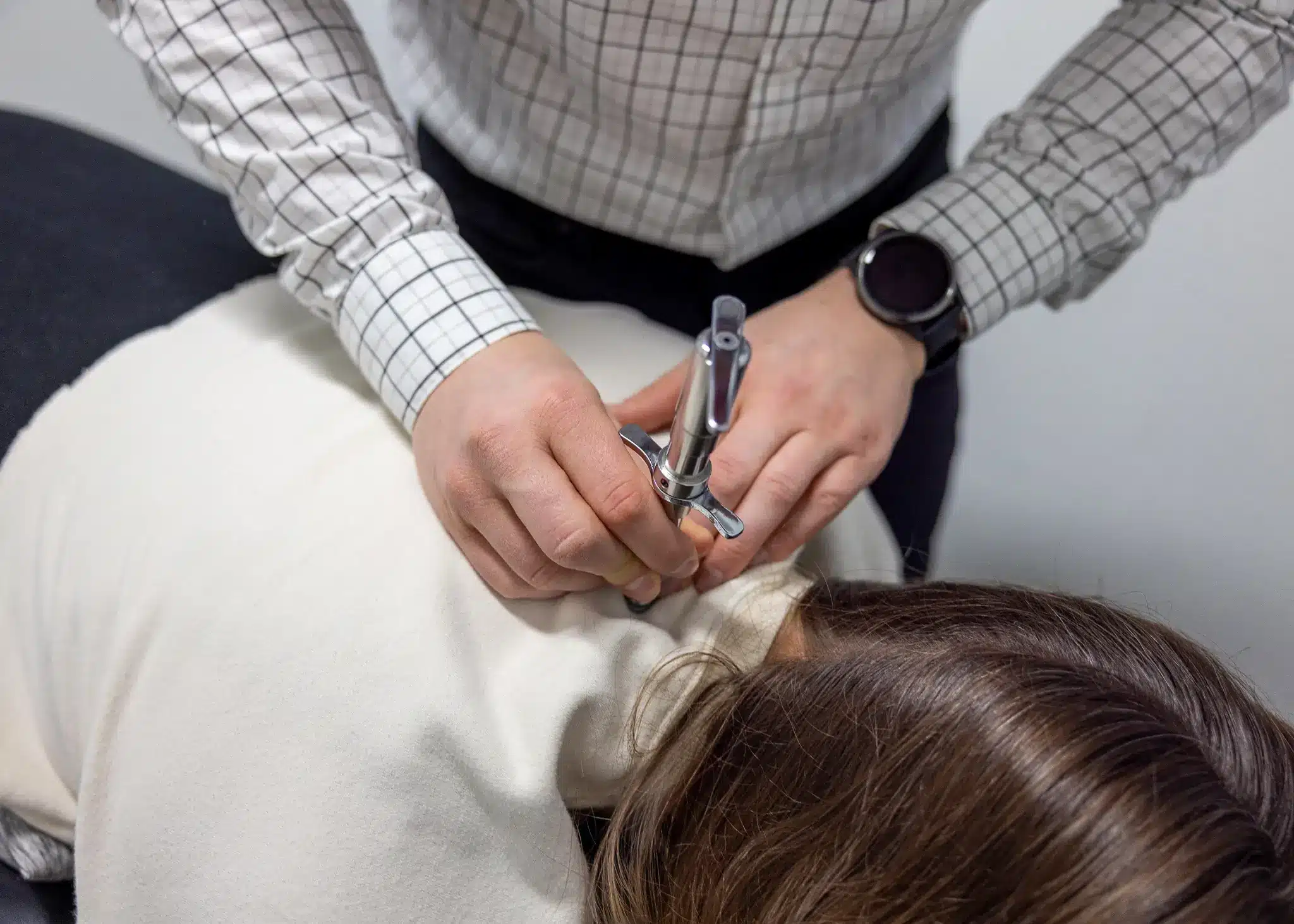
Where an instrument is used, it’s the Integrator, the hand-held tool used in Torque Release Technique. Its force is adjustable down to levels appropriate for newborns, and it delivers a controlled impulse in approximately one ten-thousandth of a second — faster than the body can tense up in response. TRT is our primary adjusting technique, and when a case calls for it our doctors still use skilled manual adjustments, sometimes in combination.
And you won’t be watching from a waiting room. You will be with your child for every part of their visit, from the consultation through the adjustment itself. We never separate a child from their parent or guardian.
What ICPA Certification Means — and Why You Should Ask About It
If you take one practical thing from this article, make it this: ask any chiropractor you’re considering whether they hold ICPA certification, and don’t accept “I see kids all the time” as an answer.
The International Chiropractic Pediatric Association provides advanced training focused specifically on chiropractic care for infants, children, and families. That training covers:
- Pediatric spinal development
- Birth stress and infant care
- Age-specific adjustment techniques
- Family wellness chiropractic care
Every doctor on staff at Restoration holds this child-specific certification — one most chiropractors don’t have. Every chiropractor here is also Advanced Proficiency Certified in Torque Release Technique, the highest level of training available in that technique.
This is a real filter, not a marketing badge. A chiropractor without pediatric-specific training may be excellent with adults and still be carrying an adult mental model into a body that doesn’t work like one. Avoid any provider who uses the same force and technique on kids as they would on adults.
The Reasons Prosper Parents Actually Bring Babies In
Chiropractic care doesn’t treat or cure medical conditions — but here is what families are most often hoping to improve when they walk through the door.
- Colic and digestive trouble. The unsettled, inconsolable, up-all-night stretch. Gentle adjustments support nervous system function, which can improve digestion, reduce gas and reflux, and bring relief to unsettled babies.
- Nursing and latch difficulties. Babies who favor one side at the breast, or who can’t turn far enough to latch comfortably, are a common referral from lactation consultants.
- Torticollis and limited head turning. Limited head rotation, neck tension, or a consistent head tilt can often be addressed with gentle adjustments specific to infant and toddler anatomy.
- Sleep. When the nervous system is in balance, children relax more easily and sleep more deeply. Many parents report noticeable improvement within just a few visits.
- Recurring ear infections. A frequent reason families come in looking for something other than another antibiotic cycle. Chiropractic care can help support proper drainage and reduce the nerve tension that contributes to recurring ear infections in young children.
One Prosper parent described the torticollis experience this way in a Google review: “My daughter was diagnosed with torticollis — she only really looked/turned in one direction. After a few weeks of chiropractic care we saw her range of motion increase dramatically.”
Individual results vary, and none of the above replaces medical diagnosis or treatment.
What Happens at Your Baby’s First Visit
Four steps, one visit, no surprises.
- Consultation. We take time to understand your child’s health history, development, and symptoms — so we can identify exactly what’s going on before we do anything else.
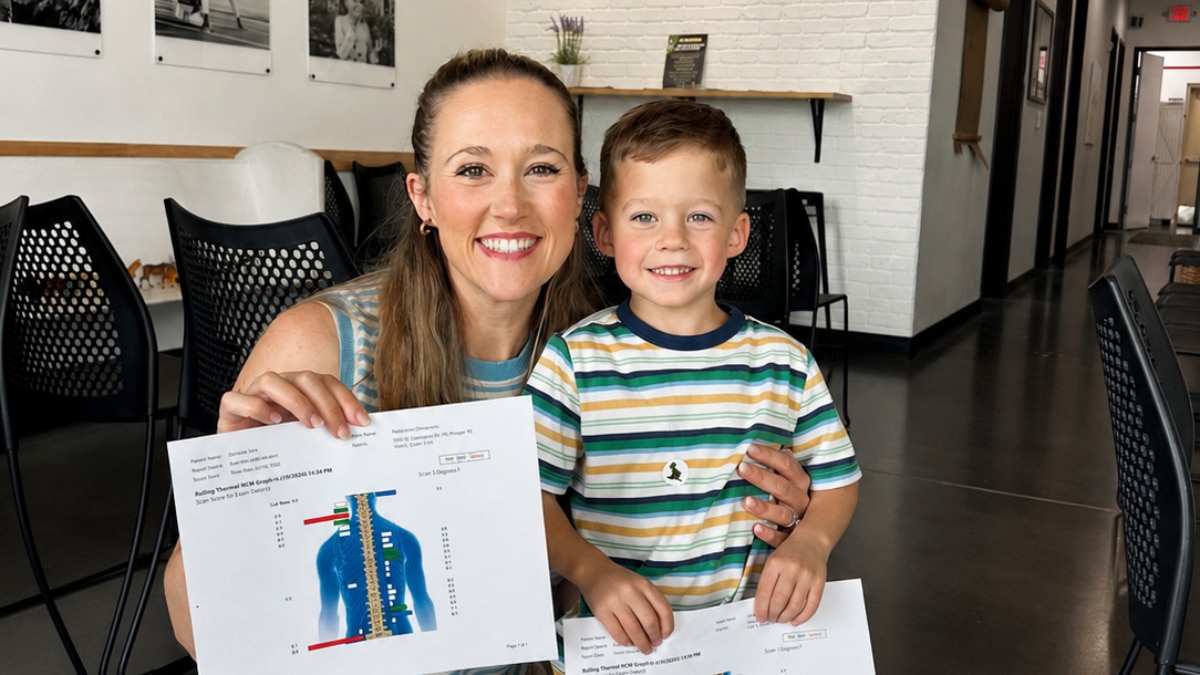
- Evaluation. A short, age-appropriate assessment to see exactly how your child’s nervous system is functioning — no guessing, no assumptions.
- Doctor’s Report. We walk you through exactly what we found and a gentle, personalized strategy tailored to your child.
- First Treatment. Light, safe, precise pediatric adjustments. Most parents are surprised by how calm and comfortable their child is.
One question comes up constantly: do you X-ray babies? Digital X-rays are used when necessary for accuracy, and they are rarely needed for young children. For infants, the evaluation is the age-appropriate assessment described above.
When to Call Your Pediatrician First
We’d rather say this plainly than leave you to guess. Chiropractic care, including Torque Release Technique, is not a substitute for diagnosis or treatment of specific medical conditions. Call your pediatrician first — not us — if your baby:
- Has a fever
- Is refusing to feed
- Is unusually lethargic or hard to rouse
- Isn’t producing wet diapers
- Has had a fall or injury you’re worried about
Those are medical situations and they need a medical evaluation.
We also work alongside your child’s broader care team rather than in place of it — your pediatrician included, and often a lactation consultant or feeding specialist when latch is the issue. If you’re unsure whether chiropractic can help your child’s specific situation, call us before you book. We’re happy to talk it through.
How to Choose a Chiropractor for Your Baby in Prosper
Four things worth checking, in roughly this order:
- Pediatric-specific training. ICPA certification is the gold standard. Ask directly — and ask whether every doctor in the practice holds it, or just one.
- A genuinely family-focused practice. Clinics that regularly care for infants, children, and parents tend to create a more comfortable experience for young patients. A practice that adjusts a newborn once a month is a different proposition from one that does it daily.
- Gentle, specific technique. Children require extremely light adjustments tailored to their stage of development. Ask what technique they use on infants and what the force actually feels like. A good answer is specific; a vague one tells you something too.
- A track record with local families. Restoration has 525+ five-star reviews from Prosper, Celina, and Frisco families we’ve cared for since 2018. Review volume sustained over years is a genuine quality signal — then read them for fit, looking for parents describing a situation like yours rather than just a high number.
Book a Gentle Newborn Check in Prosper
If you’ve been wondering whether your baby’s fussiness, head tilt, or feeding struggle has a physical component worth checking, a consultation is a conversation, not a commitment — and you’ll be in the room for every second of it.
Learn more about our approach on the Pediatric Chiropractor in Prosper page, read up on the gentle, low-force method we use on infants at Torque Release Technique, or book an appointment and we’ll take it from there. You can also reach the team at (972) 818-5820 with questions before you book.
We care for families across Prosper, Celina, Aubrey, Frisco, McKinney, and Little Elm — and we’d be glad to meet yours.