Ear infections are one of the most common reasons parents take a child to the doctor. By age three, roughly 80% of children have had at least one. For a lot of families, that first infection starts a cycle that’s hard to break: antibiotics, a few good weeks, another infection, more antibiotics, and eventually a conversation about ear tubes.
If you’ve landed here, you’ve probably already had that conversation — or you’re trying to avoid it. So let’s answer the question directly before getting into the details.
The Short Answer
- Chiropractic doesn’t treat the infection itself — it supports the drainage that influences how often infections keep coming back. Diagnosing and treating an active infection is your pediatrician’s job.
- Most middle ear infections are a plumbing problem. The Eustachian tube isn’t clearing fluid. Gentle upper-cervical adjustments aim to reduce nerve tension in the region that controls the muscles around that tube.
- The research is encouraging. The largest study of its kind followed 401 children and found a strong correlation between chiropractic adjustments and resolution of otitis media.
- What we see in our office backs that up. Recurring ear infections are one of the most common reasons families bring a child to us, and it’s one of the areas we feel most confident about — though no one can honestly promise you a result.
- It works alongside pediatric care, not instead of it. The goal is fewer infections over time, not skipping the doctor when your child is sick.
- Best fit: children stuck in a recurring cycle. For a single acute infection, it’s usually not the first thing to reach for.
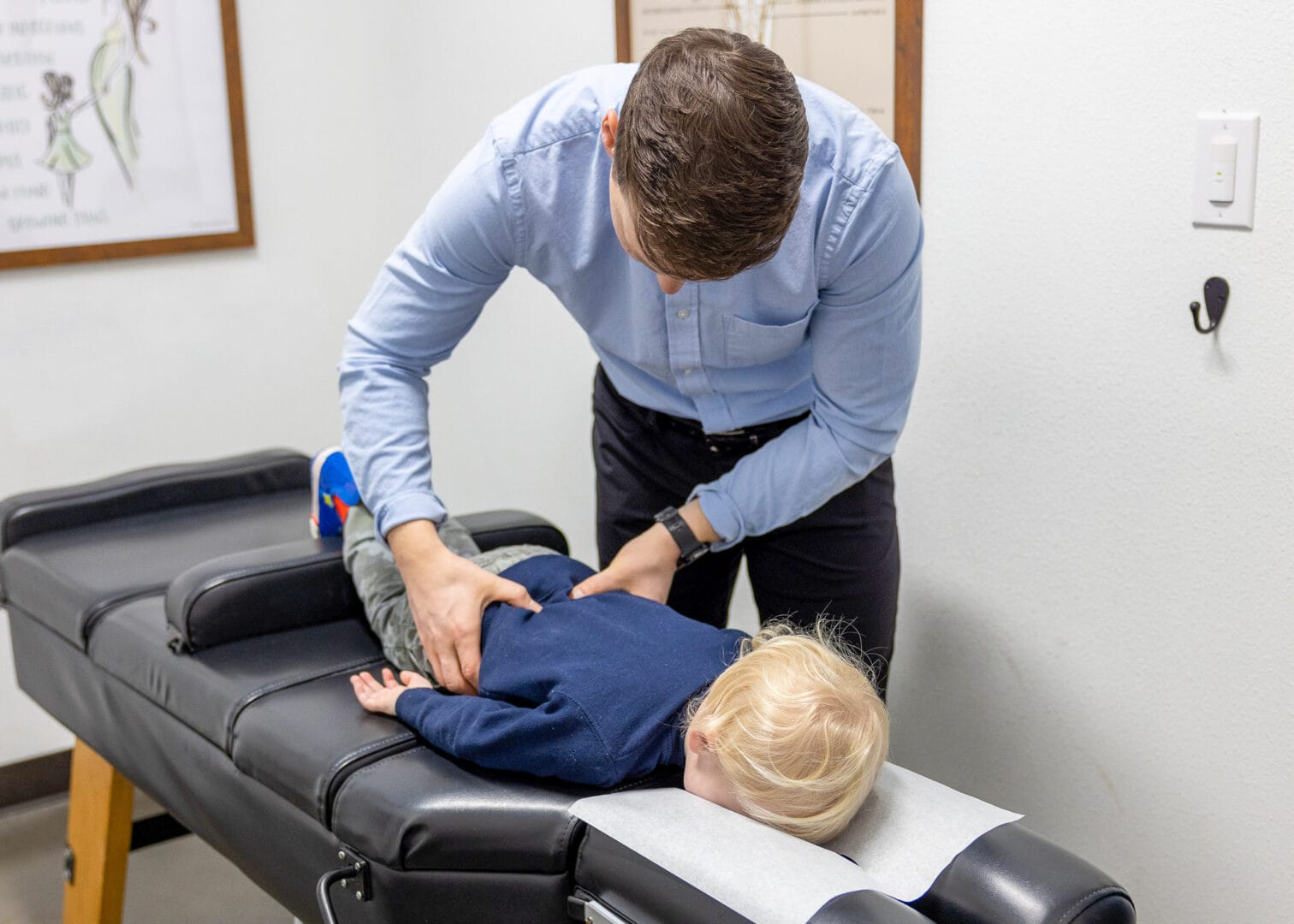
- Adjustments for kids are very light — about the amount of force you’d use to check the ripeness of a tomato. No cracking, no twisting.
Can a Chiropractor Help With Ear Infections?
The accurate answer is: a chiropractor doesn’t treat the infection — they work on the drainage problem that keeps letting it come back.
That distinction matters. An acute ear infection is bacterial or viral, it’s diagnosed with an otoscope, and it’s managed by your pediatrician — and we’ll always tell you so.
What a chiropractor works on is the mechanical and neurological side of why fluid keeps getting stuck in the first place. Chiropractic care can help support proper drainage and reduce the nerve tension that contributes to recurring ear infections in young children. For a lot of families, that’s the part nobody has addressed yet — every visit so far has treated the current infection, and none has looked at why they keep happening.
Note the word recurring. That’s the population this is actually aimed at — the child on their fourth round of antibiotics this year, not the child with their first sore ear on a Tuesday night.
Why Kids Get So Many Ear Infections
Most middle ear infections come down to one thing: the Eustachian tube isn’t draining properly.
The Eustachian tube connects the middle ear to the back of the throat. Its job is to equalize pressure and drain mucus out of the middle ear — it’s what makes your ears “pop” on an airplane.
In children, this tube is shorter, narrower, and far more horizontal than in adults. That anatomy makes it much easier for fluid and bacteria to get trapped behind the eardrum, and it’s the single biggest reason kids get ear infections and adults mostly don’t. It’s also why many children simply outgrow the problem — the tube lengthens and angles downward as they develop.
When a cold, flu, allergy, or sinus inflammation swells the throat and Eustachian tubes, fluid backs up in the middle ear. If the tube can’t drain, pressure builds, bacteria multiply, and you get the familiar picture: pain, pressure, fever, irritability, and a household that isn’t sleeping.
What a Chiropractor Actually Does for Recurring Ear Infections
The muscles that open the Eustachian tube and let it drain are controlled by nerves that exit the base of the skull and pass through the upper cervical spine. Where there’s tension or restriction in that region, the theory is that drainage is impaired.
A chiropractic visit for a child with recurring ear infections is aimed at that region. At our practice this means neurologically-based chiropractic care using Torque Release Technique — a hand-held instrument called the Integrator that delivers a precise, pre-calibrated impulse, with no twisting or popping. TRT is our primary adjusting technique, and when a case calls for it our doctors still use skilled manual adjustments, sometimes in combination with TRT.
The goal is not to “cure” the infection. It’s to reduce interference in the nerves serving that area, support fluid drainage, and give the child’s own immune system a better shot at clearing things — and at not repeating the cycle in six weeks.
What it feels like: adjustments for infants and children use dramatically lighter pressure than adult adjustments, often just the amount of force you’d use to check the ripeness of a tomato. No cracking, no twisting — just light fingertip pressure sized to your child. Most parents are surprised by how calm and comfortable their child is, and you stay with your child for the entire visit.
Babies, Toddlers, and Older Kids: What’s Different
Parents search this by age for good reason — the approach genuinely differs.
Babies (0–12 months). The birth process itself can stress a newborn’s spine and nervous system, and early checks are aimed at addressing things like latch difficulties, sleep issues, and torticollis before they compound. The Integrator’s force is adjustable down to levels appropriate for newborns. If your baby is under 6 months and showing any signs of infection, that’s a pediatrician call first, every time — see the section below. For a fuller picture of infant care, we wrote a separate guide to newborn and infant chiropractic.
Toddlers and young kids (1–5). This is the peak window for recurring ear infections and the age group where parents most often come to us mid-cycle. It’s also the age where the antibiotic-infection loop tends to be most entrenched. Care is gentle and age-scaled, and visits are short.
Older kids (6+). Ear infections usually taper off as the Eustachian tube matures. When they don’t, or when there’s persistent fluid and hearing concern, an ENT referral is often the right path — and we’ll say so.
What the Research and Our Own Experience Show
Chiropractic care for children with recurring ear infections has been studied, and the findings are encouraging.
Fallon & Edelman (1998), Chiropractic Care of 401 Children with Otitis Media: A Pilot Study, published in Alternative Therapies. The largest study of its kind. Across 401 children, it found a strong correlation between chiropractic adjustments and the resolution of otitis media.
Peet, Chiropractic Results With a Child With Recurring Otitis Media Accompanied by Effusion, in JB Chiropractic Pediatrics. A five-year-old had been getting ear infections every three to six weeks for a year. Across six months of chiropractic care, the child had just one — with mild effusion.
Irritable Child with Chronic Ear Effusion/Infections Responds to Chiropractic Care. An 11-month-old with chronic ear infections since birth. After eight weeks of care, the child had gone a full month without an infection and without any prescribed medication. Parents and caregivers also noticed improvements in personality and behavior.
And what we see in our own office. We’ve been caring for families in Prosper since 2018, and recurring ear infections are one of the most common reasons parents bring a child through our door. Across hundreds of children, we’ve had the same experience over and over: a family arrives worn down, mid-cycle, several rounds of antibiotics deep — and over the following weeks the pattern starts to break. That’s clinical experience rather than a controlled trial, and we’ll always be upfront about the difference. But it is remarkably consistent, it lines up with what the published research points toward, and it’s one of the reasons pediatric care is the part of this practice we feel most strongly about.
What we won’t tell you. We won’t promise your child a result. The published work here is made up of pilot and case studies rather than large randomized trials, every child is different, and some children outgrow ear infections on their own as the Eustachian tube matures. What we will do is give you a straight assessment of whether we think your child is a good candidate — and tell you plainly if we don’t think we’re helping.
The Standard Treatment Approach — and Why Parents Look for Alternatives
Most ear infections improve within a few days, and many resolve on their own within one to two weeks. When they don’t, the standard next step is antibiotics.
Antibiotics work for bacterial infections. The friction, for families in a recurring cycle, is:
- Many ear infections are viral and don’t respond to antibiotics at all
- Repeated courses can affect gut health and the developing immune system
- Overuse contributes to antibiotic resistance over time
- They address the current infection, not the drainage pattern underneath it
None of that makes antibiotics the enemy — when a child needs them, they need them. It’s why families with a recurring pattern start looking for something that addresses the pattern rather than each individual flare.
When to See Your Pediatrician First
Chiropractic care is complementary. It is not a substitute for medical evaluation, and there are situations where the pediatrician comes first, full stop. Take your child in if they:
- Have a high fever (over 102.2°F / 39°C)
- Have severe ear pain
- Have symptoms that worsen, or don’t improve after a few days
- Have fluid or discharge draining from the ear
- Show any signs of hearing loss
- Are under 6 months old with any signs of infection
Also worth a medical conversation: persistent fluid behind the eardrum without infection, any speech delay, or a pattern your pediatrician thinks warrants an ENT referral.
For most families, this works best alongside standard pediatric care. The goal is fewer infections overall — not avoiding the doctor when your child needs one.
How to Choose a Chiropractor for Your Child’s Ear Infections
Not every chiropractor is trained to work with children, and this is worth checking before you book anywhere — including with us.
- Look for pediatric-specific certification. The ICPA (International Chiropractic Pediatric Association) offers post-graduate credentials specifically for pediatric care. It’s a real, verifiable credential — ask, and ask whether every doctor in the practice holds it or just one.
- Ask what technique they use on children, and what the force actually is. You want a clear, concrete answer.
- Ask whether you stay in the room. The answer should be yes.
- Listen to how they talk about outcomes. You want someone who can explain the drainage mechanism clearly, is confident about what they see clinically, and is equally clear about when your child needs a pediatrician instead. Guaranteed outcomes are worth a raised eyebrow in any field of healthcare.
- Ask how they’ll know if it isn’t working, and what the plan is then.
For what it’s worth on our end: every doctor on staff at Restoration holds ICPA certification — a child-specific credential most chiropractors don’t have — and all of our doctors are Advanced Proficiency Certified in Torque Release Technique. We’ve been serving families in Prosper since 2018, with 525+ five-star reviews.
Common Questions
Can a chiropractor help with ear infections?
Not by treating the infection itself — but by supporting the drainage and nerve function that influence how often infections come back. It’s best suited to children stuck in a recurring pattern, it works alongside your pediatrician’s care, and it’s one of the most common reasons families bring a child to us.
Can chiropractic cure an ear infection?
An active infection is a medical matter, and nobody should promise you a cure. What chiropractic care aims to do is support the drainage that influences how often infections return.
Can a chiropractor help with fluid in the ear?
Fluid behind the eardrum (effusion) is the drainage issue at the heart of this, and it’s what gentle upper-cervical care is aimed at supporting. Persistent fluid still needs medical evaluation, particularly where hearing is a concern.
Is it safe for a baby?
Adjustments for infants use a fraction of adult force — light fingertip pressure, no cracking or twisting, scaled to the child. Safety depends heavily on the practitioner’s pediatric training, which is why ICPA certification is worth asking about.
Should we stop antibiotics if we start chiropractic care?
No. Never stop a prescribed medication because you’ve started chiropractic care. That’s a conversation for your pediatrician, not your chiropractor.
How many visits before we’d know?
It varies by child and by how long the pattern has been running. You should expect a practice to tell you up front roughly when you’d reassess — and to be honest with you if it isn’t helping.
Does my child need X-rays?
Rarely. Imaging is not routine for young children in our office; the pediatric evaluation is age-appropriate rather than a scaled-down adult workup.
Talk to Us About Your Child’s Ear Infections
If your child is stuck in the antibiotic-infection-antibiotic loop and you’re looking for something that addresses the pattern rather than each flare, gentle chiropractic care may be worth a conversation.
We’ll do a thorough evaluation, talk through your child’s history, and give you a straight answer about whether we think we can help — including telling you if we don’t think we’re the right fit. Learn more about our pediatric chiropractic care, or schedule a consultation and we’ll get to know your family.