It’s 5:15 p.m. You’re 26 weeks along, dinner isn’t started, and a toddler is standing at your knees with both arms straight up in the air. So you scoop. That’s maybe the thirtieth time today, and it isn’t bath time yet.
Then there’s the car seat, the crib rail, the grocery cart, and the hundred small pick-ups in between. Somewhere around week 20 your body started sending notes: a deep ache low in your back, a sharp catch at the front of your pelvis when you roll over at night, a hip that complains every time you climb the stairs with someone on it.
If that’s your life right now, you’re in good company, and you don’t have to grit your teeth until the baby arrives. This is one of the most common things we help pregnant moms with.
The Short Version
- The problem: Pregnancy loosens the ligaments around your pelvis and shifts your weight forward. Add a toddler you’re lifting all day, and your back and pelvis are doing double duty. Pelvic pain gets more common with every baby you’ve already had.
- What helps: A few small changes in how you lift, carry, sleep and stand. Six are below, and most of them cost nothing.
- When that isn’t enough: Gentle, Webster Certified chiropractic care keeps your pelvis balanced while you keep up with a toddler, and your toddler is welcome to come along.
Why Baby #2 (or #3) Hurts More
Ask any mom who’s done it twice and she’ll tell you the second pregnancy felt different. The research agrees.
In a study of nearly 76,000 Norwegian women, 11% of first-time mothers had developed pelvic girdle pain (pain at the front of the pelvis and on both sides at the back) by week 30. Among women who’d already had one baby, it was 18%. Among women who’d had two, it was 21%. Severe pain climbed even faster. The study can’t tell us why. But anyone who has carried a 25-pound toddler up a flight of stairs has a theory.
And you’re not imagining how common it is. Depending on how pain is counted, estimates run from about 45% of pregnant women to more than two-thirds, and it typically gets worse as pregnancy goes on, getting in the way of work, daily activities and sleep.
What a Toddler Does to a Pregnant Pelvis
Your pelvis isn’t one bone. It’s a ring, with a sacroiliac (SI) joint on each side at the back, where your spine meets your hips, and one joint at the front, at the pubic bone. During pregnancy the hormone relaxin loosens the ligaments that hold that ring steady so it can open for birth. Your growing uterus shifts your center of gravity forward and stretches your abdominal muscles, and the extra weight means more work for every muscle and joint.
A loosened, loaded pelvis is easier to knock out of balance, and a toddler on the same hip dozens of times a day is a very good way to do it. When the joints move unevenly, it can show up as pain at the front over your pubic bone, across one or both sides of your lower back, or spreading into your thighs. It’s usually worst at exactly the moments a mom of a toddler can’t avoid: walking, stairs, getting dressed standing on one leg, turning over in bed, and getting out of the car.
Six Things to Try This Week
Start here. Most of these cost nothing, and most come straight from the American College of Obstetricians and Gynecologists.
- Lift from a squat, not your waist. Bend your knees and keep your back straight. Your toddler won’t mind the extra second.
- Bring them to you. Sit on the couch or the edge of the bed and let your toddler climb into your lap, instead of scooping them up from the floor.
- Switch hips, or skip the hip. Alternate sides, hold them close to your body, and hold hands and walk whenever they’re willing.
- Sleep on your side, with pillows. Keep your knees bent, with one pillow between your knees and another under your belly. A full-length body pillow works too.
- Check your shoes, and give your back a break at the sink. Low heels with good arch support, never high heels. If you’re standing a long time (bath time, dishes), rest one foot on a stool.
- Keep moving. Walking is generally safe during pregnancy, and staying active reduces back pain. When researchers pooled the evidence from 32 studies, women who exercised during pregnancy had less severe back and pelvic pain than those who didn’t. Check with your OB before starting or changing a routine.
Give it a week or two. If you’re feeling better, keep going. If you’re not, or if it’s severe, read the next section and then make a call.
When to Call Your OB or Midwife First
Most pregnancy back and pelvic pain is the ordinary, mechanical kind. Some isn’t, and that kind needs your OB or midwife before anyone else. Call them first if:
- Your back pain is severe, or has gone on for more than two weeks.
- Back pain comes with a fever, burning when you pee, or vaginal bleeding.
- You’re before 37 weeks and the pain is severe or feels unusual. Back pain can be a sign of preterm labor.
- You have pain in the side, under your ribs.
- You lose feeling in a leg, your bottom, or your genital area. That’s an emergency room visit, not a phone call.
We ask about all of this at your first visit, and we work alongside your OB or midwife. If something calls for another provider, we’ll tell you.
How We Help at Restoration
Changing how you lift changes how much load goes through your pelvis. It doesn’t change a pelvis that has already drifted out of balance. That’s the job of a Webster Certified prenatal chiropractor in Prosper, and it’s what we do every day at Restoration.
The Webster Technique is a specific analysis and gentle adjustment of the sacrum, the triangular bone at the back of your pelvis, aimed at easing dysfunction in the sacrum and SI joints so your pelvis can sit in better balance. It works on your pelvis, never the baby. Every doctor on staff is Webster Certified, which means post-graduate training in caring for pregnant bodies. (Here’s what “Webster Certified” actually means.)
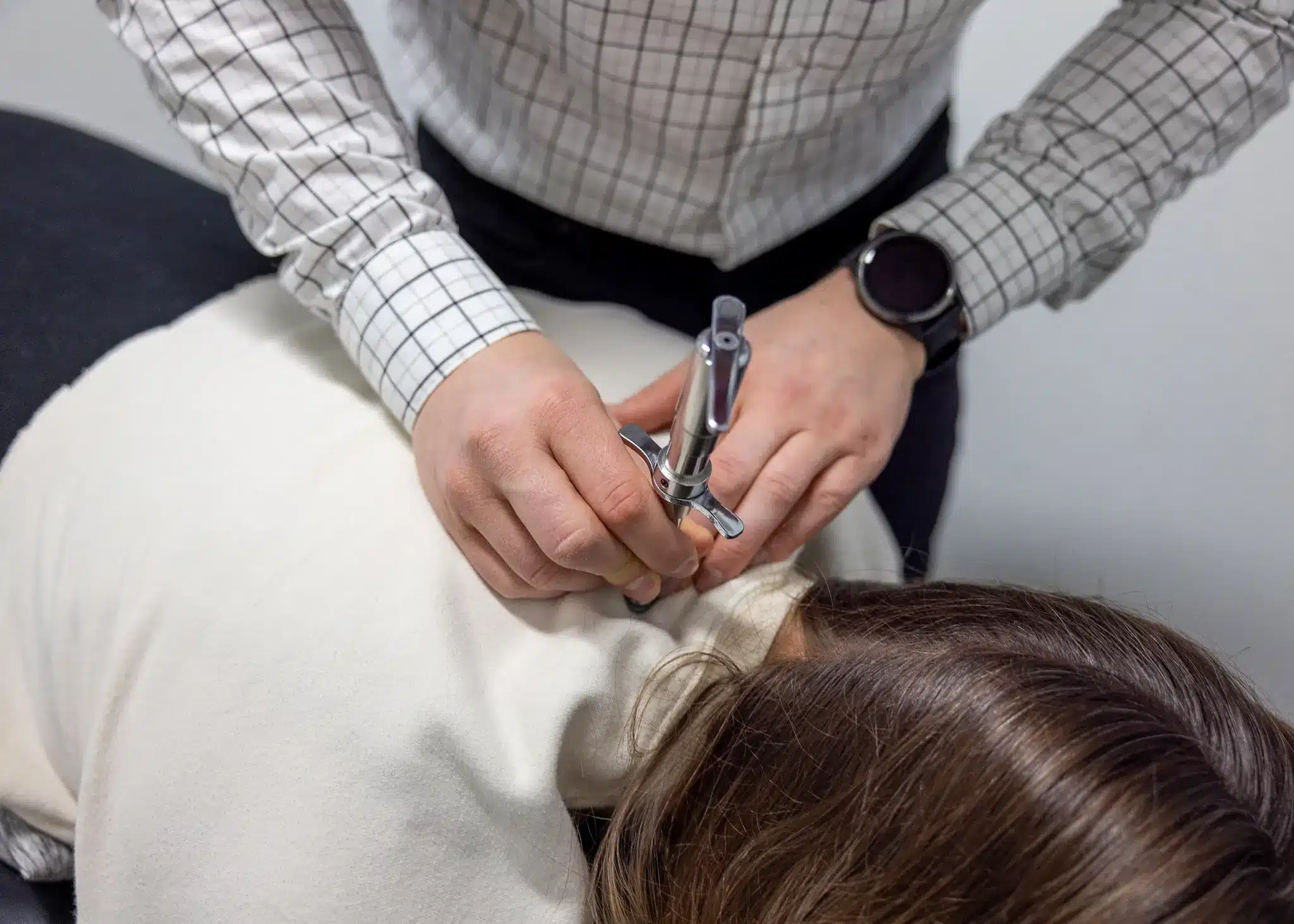
We pair it with Torque Release Technique, our primary adjusting technique, which uses a small hand-held instrument called the Integrator. It delivers a quick, light impulse: no twisting, no cracking, no pressure on your belly. It’s widely used alongside the Webster Technique throughout pregnancy, and when a case calls for it, we also use skilled manual adjustments.
What a visit looks like:
- We start with you. A consultation about your pregnancy and your pain, then a gentle evaluation: a hands-on assessment plus a nervous-system scan, with no X-rays during pregnancy. Then a clear, simple explanation of what we found and a plan built around you. See what to expect at your first visit.
- You get your first adjustment the same day. In most cases, you’ll be adjusted at your first visit.
- It’s built for a belly. Pregnancy pillows and tables designed to comfortably accommodate your growing belly.
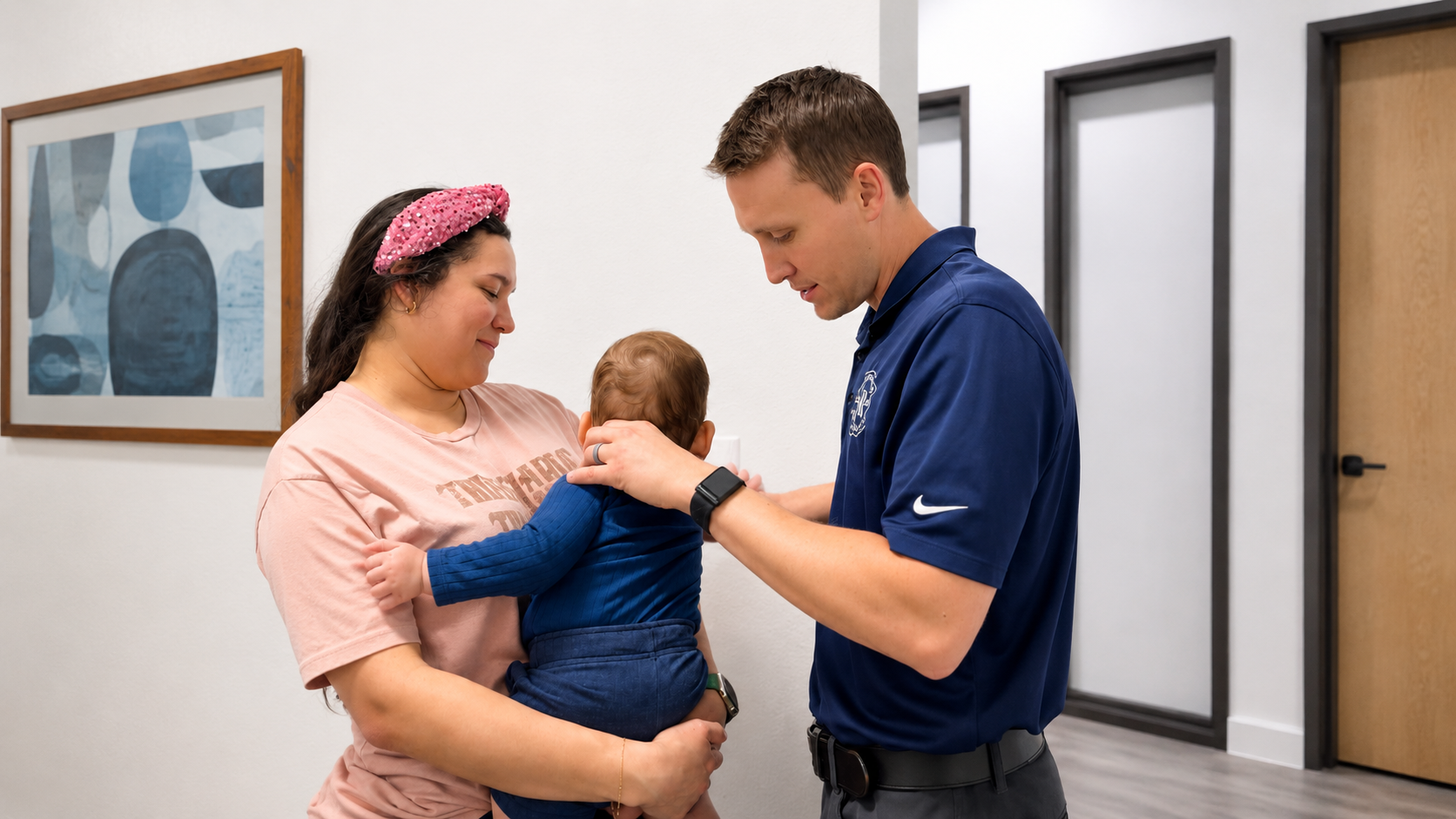
- Bring your toddler. We’re a family practice, and you’re welcome to bring your kids with you. Our doctors are also ICPA-trained in pediatric care for the day your little one needs their own visit.
- It’s a rhythm, not a one-off. Most of our prenatal patients come weekly or every other week, and any trimester is a good time to start. If you’re already in your third trimester, it’s still worth coming in.
“In my previous & current pregnancy, I’ve experienced a significant amount of hip & SI pain that really got in the way of daily life with littles. Within a month & a half of beginning visits here, my hip pain has almost completely gone away, my sleep is significantly improved, and I feel so much more comfortable.”
— Restoration patient, verified Google review
The research is moving in the same direction. A 2020 systematic review of chiropractic care for pregnancy-related low back and pelvic pain, covering 50 published studies and reviews, found the evidence for chiropractic care points in a favorable direction.
Why we like to see moms through to the other side. ACOG notes the pain usually eases after the baby arrives, but for many women back pain lingers for months. That’s a hard plan when you’re about to carry a newborn and a toddler. Our prenatal care continues postpartum, with gentle adjustments for the strain of nursing and carrying, and when your newborn is ready, infant chiropractic care is here too.
One Honest Thing
We can’t promise a pain-free pregnancy, and chiropractic doesn’t replace your OB or midwife. Some moms feel a difference the same day, and for others it builds over a few weeks. What we will do at your first visit is tell you plainly what we find, whether we’re a good fit, and what a plan looks like, before you commit to anything.
Take Care of the One Who’s Taking Care of Everyone
You’re lifting, carrying, soothing and growing a person, all at once. You don’t have to hurt through it.
Read how prenatal chiropractic works at Restoration, then book an appointment. Looking for a pregnancy chiropractor in Prosper, TX? We’re on North Coleman Street, and moms drive in from Celina, Frisco, McKinney and across North Texas. If you want a Webster Certified chiropractor near you, we’d love to meet you, and your toddler.
Or call (972) 818-5820 and ask us whether it’s worth coming in.