Search “best chiropractor in Prosper” and you’ll get a screen full of offices with nearly identical five-star ratings, similar-sounding websites, and no obvious way to tell them apart. It’s a frustrating way to make a decision about your spine — and it’s the reason most people end up just picking whoever is closest to the Preston Road exit.
There’s a better way to narrow it down. Not because there’s one objectively best chiropractor in town, but because there are real, checkable differences between practices that almost nobody thinks to ask about.
TL;DR: “Best” isn’t a universal title — it’s a fit question. The things actually worth comparing are how a practice adjusts, whether they examine and image your spine before touching it, whether they hold credentials for your specific situation (pregnancy, kids, athletes), and whether they’ll tell you honestly when chiropractic isn’t the answer. Reviews matter too — just not the way most people read them.
Reviews Are Worth More Than a Glance — But Read Them Properly
Ratings are the first thing everyone looks at, and they genuinely are informative. The thing is, the average is the least interesting part. What matters is how many reviews sit behind it, and how consistent they’ve stayed over time.
A perfect 5.0 built on fifteen reviews tells you almost nothing. A 4.9 built on more than 500 reviews is a substantially stronger signal — sustaining that across hundreds of patients over several years is very hard to fake and far too consistent to be luck. It’s evidence that a practice delivers the same experience on an ordinary Tuesday afternoon as it does on its best day. That’s the standard worth holding any Prosper practice to, and it’s one we’ve worked hard to earn.
Once you’re looking at practices in that tier, the tiebreaker is fit. Read for patterns, and see whether people like you show up in them: multiple reviews from pregnant patients, from parents bringing in kids, from athletes, from someone describing the condition you actually have. A highly-rated practice whose reviews never mention prenatal care is telling you something useful about what they do all day.
Start With How They Adjust
This is the single biggest difference between chiropractors, and the one patients most often discover only after they’re already on the table.
Traditional manual adjusting is what most people picture — hands-on, twisting, and the cracking sound that comes with it. It works well for plenty of people. It’s also the reason a lot of people never try chiropractic at all, or try it once and don’t come back.
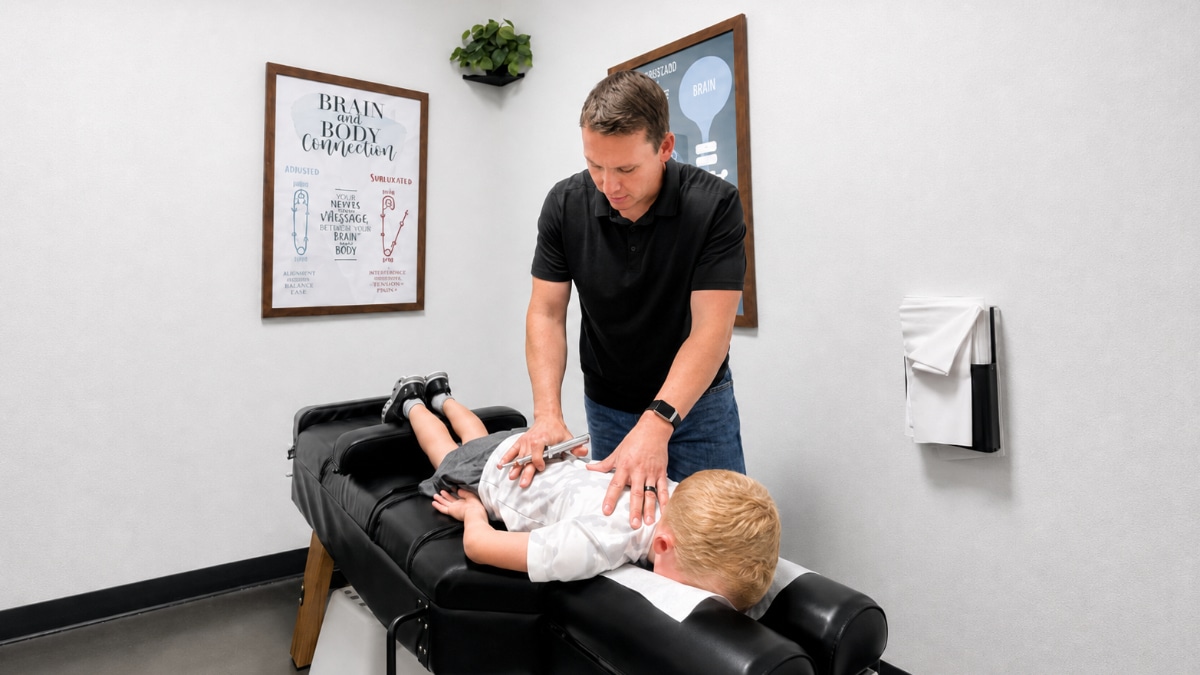
The alternative is instrument-based, low-force adjusting. At Restoration, our primary method for every patient is Torque Release Technique (TRT), which delivers the correction through a hand-held instrument called the Integrator — no twisting, no cracking, no popping. The impulse is delivered in roughly one ten-thousandth of a second, faster than your body can tense up against it, at a pre-calibrated force that’s identical every time.
That consistency matters more than it sounds. Manual adjusting varies with the doctor’s positioning, angle, and how much force they apply on a given day. An instrument delivers the same correction the same way every visit — and the force can be dialed down safely for an infant, a pregnant patient, or someone with osteoporosis.
What technique shouldn’t be is dogma. TRT is where we start with every patient, but when a case genuinely calls for a skilled manual adjustment, our doctors provide that too — sometimes in combination with TRT. That’s the honest version of this criterion: what you want from any practice isn’t one tool used on everybody regardless, it’s a clear primary method plus the judgment to adapt when your case warrants it. So ask both questions — what do you lead with, and when would you do something different?
Learn more about Torque Release Technique →
Find Out What Happens Before the First Adjustment
Here’s the question that separates practices fastest: ask what happens on your first visit, and listen for whether you get adjusted before anyone has actually looked at your spine.
Some offices will adjust you on day one, within a few minutes of meeting you. That’s fast, and it feels efficient — but it means the plan for your spine was built on a conversation and a hands-on feel, not on data.
A thorough first visit takes longer. Ours runs 45 to 75 minutes, and it includes a real consultation about your history and goals, an objective evaluation of how your nervous system is functioning, and imaging when it’s appropriate. We use NASA-certified scanning technology for the neurological piece, and on-site digital X-rays for the structural picture, with images available immediately for review. Digital imaging uses significantly less radiation than traditional film — and we skip X-rays entirely if you’re pregnant or a small child, relying on the hands-on exam and scanning instead.
You don’t need every practice to do it exactly this way. You do want to know that someone gathered real information about your spine before deciding what to do with it.
See what to expect at your first visit →
Match the Credentials to Your Situation
“Chiropractor” is one license covering a very wide range of focuses. Credentials only matter to the degree they line up with why you’re actually going.
- Pregnant? Look for Webster Certification specifically. It’s a distinct technique for pregnancy-related pelvic balance, and not every chiropractor is trained in it.
- Bringing a child or an infant? Look for ICPA training (the International Chiropractic Pediatric Association). Adjusting a newborn and adjusting a 40-year-old are genuinely different skills.
- An athlete, or recovering from a crash? Ask whether they routinely handle sports injuries or personal injury cases — the clinical side and the insurance-paperwork side both matter here.
Restoration holds Webster Certification and ICPA training, and Dr. Jake and Dr. Stephanie see patients from newborns to grandparents. That breadth is deliberate — but the point holds wherever you go: ask the question that matches your situation, not the generic one.
Pay Attention to How the Plan Gets Explained
After the exam, you should get a straight answer to three things: what they found, what they propose doing about it, and how long they expect it to take.
Be cautious of a plan that arrives as a number — a long block of prepaid visits — before you’ve been told what’s actually going on in your spine. Be equally cautious of the opposite: a vague “come back whenever it hurts” with no structure at all.
What you want is a report of findings you genuinely understand, in plain language, with the reasoning visible. If you leave the first visit unable to explain to your spouse what the doctor found, that’s a signal.
The Practical Details That Decide Whether You Actually Go
The best care plan in the world doesn’t help if the office is a 35-minute drive at 5pm. Before you commit, think honestly about:
- Location and traffic at the times you’d realistically be going
- Hours — whether there are early-morning or evening slots that survive a work schedule
- Whether the whole family can be seen in one place, which matters enormously once you’re coordinating kids
- How they handle payment — cash rates, insurance, and what a visit actually costs
We’re on N Coleman St in Prosper and see patients from Celina, Aubrey, Frisco, McKinney, and Little Elm — but the general point holds anywhere: the practice you’ll actually keep going to beats the one that looked best on paper.
Questions Worth Asking on Your First Call
If you only ask a few things, make them these:
- What technique do you lead with — manual adjusting, or instrument-based?
- What happens at a first visit, and will I be adjusted before I’m examined?
- Do you take X-rays or scans, and how do you decide when they’re needed?
- Are you certified in Webster, pediatrics, or sports care — whichever applies to me?
- What does a first visit cost, and how do you handle insurance?
- How will you explain what you find, and how will we know it’s working?
Any good practice will answer all six without hesitation. Hesitation is itself an answer.
A Good Chiropractor Will Also Tell You When It Isn’t Chiropractic
This is the quality that’s hardest to advertise, and probably matters most.
Chiropractic care isn’t the right answer for everything. Some of what walks through our door needs imaging we don’t do, a specialist we’re not, or a medical workup first — and the honest move in those cases is to say so and point people in the right direction.
A practice willing to tell you “this isn’t ours to fix” is also a practice you can believe when they tell you something is. If every problem that comes through the door somehow turns out to be treatable by the thing they happen to sell, treat that as information.
See For Yourself Whether We’re the Right Fit
You don’t have to settle this from a search results page. The fastest way to judge any chiropractor — us included — is to go through a real first visit and see how they examine you, how they explain what they find, and whether the plan makes sense to you.
That’s exactly what our new patient visit is built for: a full consultation, a nervous system scan, a thorough examination, and digital X-rays if they’re appropriate, followed by a straight conversation about what we found and whether we can help. If we’re not the right fit for what you’re dealing with, we’ll tell you that too.
Meet our doctors or schedule your first visit →, or call us at (972) 818-5820.